AI & Technology · Episode
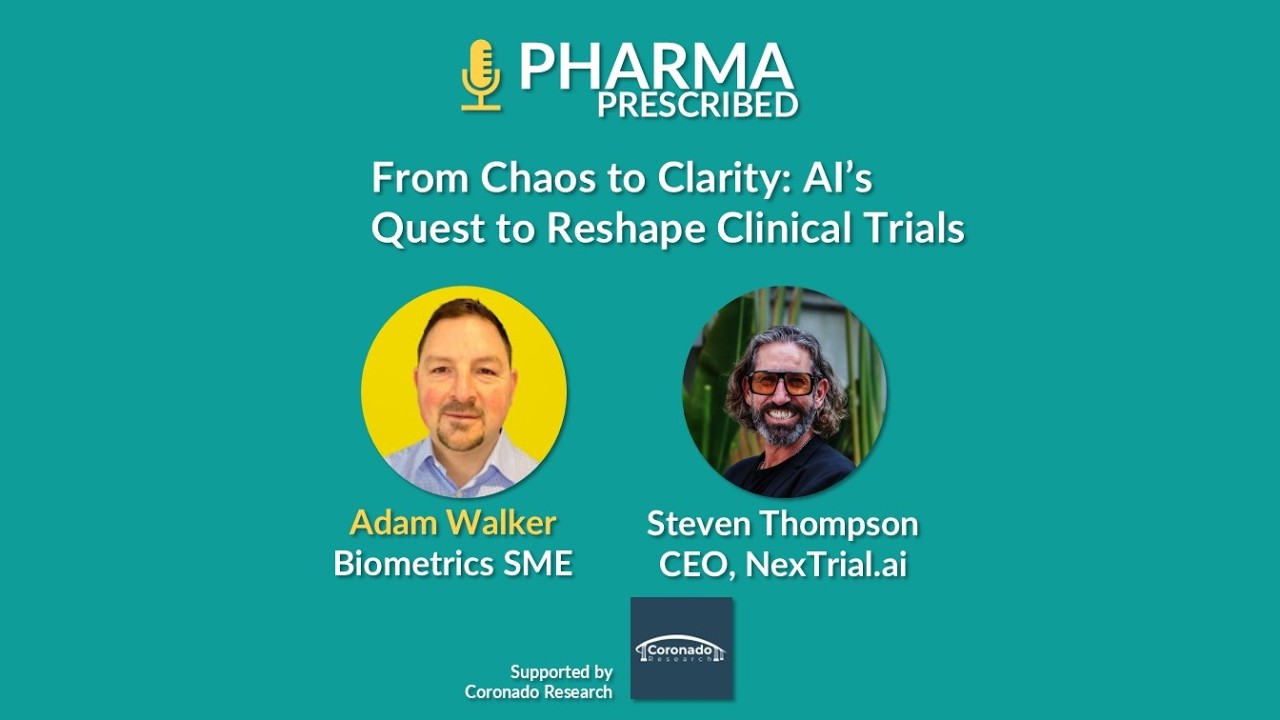
Steven Thompson — AI, Clinical Trial Activation & Why 85% of Trials Are Delayed
In this episode of the Pharma Prescribed Podcast, host Adam Walker sits down with Steven Thompson, the founder of Next Trial AI, to discuss a radical shift in how clinical trials are activated and executed. Thompson draws on his extensive background in aviation and pharma logistics to explain why 85% of clinical trials are currently delayed—not by science, but by the administrative 'regulatory maze.' He introduces the concept of trial activation intelligence, a method designed to slash startup times from months to just 30 days by utilizing deterministic, auditable AI. The conversation moves beyond mere efficiency, touching on the deeply personal motivation behind Thompson’s work. He shares how his father’s battle with cancer revealed the dark side of 'static' eligibility data and why predicting a patient's journey through a trial is a moral imperative. Listeners will gain a new perspective on how 'physics-informed' models can predict patient trajectories, the importance of verifiable AI in the eyes of regulators like the FDA and MHRA, and why Brazil is becoming a global powerhouse for clinical research data. This episode is a must-listen for anyone interested in the intersection of data integrity, human-centered design, and the future of predictable medicine.
Chapters
Approximate · derived from transcript
- 0:00Podcast Intro and Guest Setup
- 1:38Meet Steven Thompson: A Pioneer in Clinical Research
- 3:17Steven Mission and Background
- 4:56From Aviation to Pharma Purpose
- 6:35Personal Motivation: Steven's Father's Battle with Cancer
- 8:13Dad Story and Trial Reality
- 9:52Next Trial AI: Revolutionizing Clinical Trials
- 11:31Physics Informed Verified AI
- 13:10Team Talent and Brazil Base
- 14:49Life in Brazil: Steven's Personal and Professional Insights
- 16:27Brazil Healthcare Data Opportunity
- 18:06AI Boom and Model Credibility
- 19:45Human in the Loop Workflow
- 21:24Results Faster Activation Better Screening
- 23:02Meet Selena AI Persona
- 24:41Jobs Future and Personal Balance
- 26:20Roadmap Pay for Outcomes
- 27:59Quickfire Round: Personal Insights and Advice
- 29:38Conclusion: The Mission of Next Trial AI
Key insights
Compliance as Architecture Over Constraint
Clinical trials often stall for 60 to 120 days at the starting line due to paperwork and IRB rejections; Thompson argues that by treating compliance as an architecture rather than a constraint, teams can achieve trial activation in just 30 days.
Shifting from Static Matching to Trajectory Modeling
Rather than simple pattern matching to see if a patient meets criteria today, Next Trial AI uses physics-informed models to predict how a patient's eligibility and toxicity levels will evolve over the course of a trial.
Provably Right vs. Probably Right AI
To meet regulatory standards, AI must be deterministic rather than probabilistic; every recommendation must be traceable to specific regulatory clauses to avoid creating a regulatory liability.
Brazil's Untapped Potential for Data Harmonization
Brazil’s healthcare landscape offers unique opportunities for clinical research due to a willingness to collaborate and a centralized government health system containing 200 million patient records ripe for harmonization.
Democratizing Clinical Research for Naive Sites
With 97% of capable physicians currently locked out of research due to a lack of infrastructure, AI can serve as an augmentation layer that guides 'research naive' sites through complex SOPs and operational requirements.
Newsletter issue
Compliance isn't a constraint
From airline maintenance to founder of Next Trial AI — on treating regulation as architecture, making trial start-up predictable, and why patients should see the whole picture before they consent.
The written companion to this conversation with Steven Thompson. Browse the newsletter archive
Loading preview…
Full transcript
Edited for readability. Speaker labels preserved. Click to collapse.Click to expand.
Full transcript
Edited for readability. Speaker labels preserved. Click to collapse.Click to expand.
Podcast Intro and Guest Setup
Adam Walker:I am Adam Walker, a biometrics consultant, and this is the Pharma Prescribed Podcast where leaders, innovators, and hidden voices in healthcare open up, no sound bites, no spin, just raw insight, one prescription at a time in an industry driven by data protocols and press. We rarely pause to ask the human questions.
Adam Walker:What drives us, what breaks us, and what truths live behind the titles we wear.
Meet Steven Thompson: A Pioneer in Clinical Research
Adam Walker:Steven Thompson is someone who's spent more than two decades reshaping how clinical research actually gets done. He's the founder of Next trial AI and a leading voice at the intersection of AI trial activation and human-centered design in healthcare.
Adam Walker:At next trial ai, he's pioneering trial activation and execution intelligence that delivers zero rejection packets, faster startup, stronger compliance, and a future where coordinators, physicians, and teams can operate at their highest capability. Stephen brings clarity, courage, and a builder's mindset to every conversation.
Adam Walker:Steven, it's a delight to welcome you to Pharma Prescribed for anyone who's not familiar with you. Who are you and what is the mission you are on?
Steven Thompson:Thank you. Thank you, Adam. Really, it's thanks for having me. It's a pleasure again. Yep.
Steven Mission and Background
Steven Thompson:Steven Thompson, the founder of Next Trial, and we are building the infrastructure that makes clinical trials predictable.
Steven Thompson:So while others are optimizing the regulatory maze, we delete it. And as you mentioned, trial ready in 30 days and we call that trial activation intelligence. A little bit about me, I have spent my last 20 years building in regulatory environments. My first project was with American Airlines on complex maintenance and repair operations.
Steven Thompson:Governed by the FAA regulations, right Parts maintenance airworthiness. And that's really when I learned that compliance isn't a constraint. It's an architecture. That work really led me to integrate with Embr Air in Brazil. My first contact with Brazil and building the supply chain.
Steven Thompson:That's really when I fell in love with Brazil, the complexity, the sophistication where most outsiders misread that as chaos. Then I moved over to Biogen in Boston pharma operations, logistics, supply chain, and the operational backbone of getting drugs to patients. And then we moved over to Takeda.
Steven Thompson:Between Boston and Sao Paulo building data engineering pipelines for oncology and vaccines with the full inflection pipeline for drug discovery entering into trials. That's not only toxicity, genomic data efficacy, but all the data management from the discovery through to trial. And what I always saw was that on day one of an asset going into clinical trials, everything stops.
Steven Thompson:All the brilliant passionate people who built the science, they disconnect, they hand it off and they crossed their fingers and wait sixty, ninety, a hundred twenty days. And that's the gap and that's what I'm building for.
Adam Walker:It sounds like a very interesting way that you got into the pharma industry.
Adam Walker:Do you see the connection between the airline industry and pharma, and how has that played out for you?
From Aviation to Pharma Purpose
Steven Thompson:Yeah, regulations is passenger safety or patient safety, right?
Personal Motivation: Steven's Father's Battle with Cancer
Steven Thompson:So it's really the same constraints, and what really came to me personally was a couple of years ago, my, my dad passed away from cancer.
Steven Thompson:My sister's an oncology nurse at Cedar-Sinai and watching him go through that process the informed consent, the delays, the bureaucracy is something that I realized. If we knew more and had better predictions, that journey what it was gonna be like, he wouldn't have chosen it.
Steven Thompson:He would've lived his last days a little bit differently. And that's really when it became personal for me.
Adam Walker:Thank you for sharing that, and I appreciate your honesty. We have many guests on the podcast who have a personal story and. I think that really connects a mission to a purpose, doesn't it?
Adam Walker:When that happens with individuals. I have a similar story and experience myself.
Dad Story and Trial Reality
Adam Walker:If you wouldn't mind explaining a little bit more, what was it with your father's experience that really did get under your skin and drove you to make change yourself?
Steven Thompson:Yeah it was really about the hope of the clinical trial, and then as he went through the prediction the eligibility, the pattern matching of what his current status was to the eligibility criteria, and then getting approved and going through an informed consent.
Steven Thompson:It was static data. It wasn't. Can he tolerate the trial? What is his lab trajectories, aligned with his completion of the trial. And, that would've really given him the ability to make the choice upfront he wouldn't have chosen that, path.
Adam Walker:So effectively what you're saying is that without the experience, you can't predict what's coming. Of course, no one knows what's around the corner, but data being as dynamic as it is both in the medical profession, in and around humans, are you suggesting that visibility and understanding came much later rather than at the earliest stage in the conversation?
Steven Thompson:Yes, exactly he didn't have the awareness of what the outcome was gonna be and his the probability of his ability to complete and tolerate the trial. His toxicity, his his labs would've shown that he would've not been eligible, three months into the trial.
Steven Thompson:That's really what we've been working on as well as part of our physics informed prediction engine.
Next Trial AI: Revolutionizing Clinical Trials
Adam Walker:So that sounds like a nice segue into the work that you're doing with next trial ai. Tell me more about the capabilities and the understanding that platform has around developing processes for patients.
Steven Thompson:So we are a trial activation intelligence. So right now, 85% of clinical trials are delayed, and it's not because of the science, it's the paperwork. Sites at the very beginning, the starting line sites wait 60 to 120 days to activate. And every delay is a patient waiting, IRB rejection rates.
Steven Thompson:Trial activation is not the sexy part of clinical trials. The IRB rejection rates are 25 to 30% and sponsors burned, 55,000 a day On those delays. And then another problem that we've that we've identified working with some sponsors is 3% of the physicians currently are running trials today.
Steven Thompson:There's 97% of capable physicians that are locked out. It's not because they lack skills, but they lack the infrastructure, the knowledge they're really naive, research naive, right? But they're really blocked and nobody owns that starting line until now. This is why we've started with the trial activation intelligence and regulatory grade ai, which is deterministic and moved into again that physics informed approach.
Physics Informed Verified AI
Steven Thompson:So the traditional eligibility, again, the matching asks, does the patient meet the criteria today? And you know that's the wrong question. What we ask is how will the patient's eligibility evolve and when is the optimal enrollment window? Patients aren't static data points, right?
Steven Thompson:They're differential equations. So our model incorporates physics constraints. Tumor growth dynamics, lab values, trajectories, the treatment response curves, and we're not doing pattern matching. We're doing trajectory modeling. We also have a verification architecture, so we're deterministic and we're not probabilistic.
Steven Thompson:What that means is the same input is the same output every time. So our architecture is grounded in the Stanford Harvard adaption frameworks. So we use a Lean four for formal verification. So every. Decision every recommendation, every gap is logged and auditable and is repeatable five years down the line.
Steven Thompson:So again, citing, it also cites full specific regulatory clauses that get triggered. So we have a full regulatory intelligence. And it's not, here's what we think. It's here is the rule, here is the evidence, and here is the recommendation. And it's provably, right? Not probably.
Adam Walker:That's a wonderful statement.
Adam Walker:I love that provably, right? Not probably, i'm wondering from the earliest understanding of this, this sounds highly complex to me and I'm someone who's worked in clinical research for a long time. Tell me about some of the people you're surrounding yourself with, because I'm guessing that you are not the only very smart person involved in this particular activity.
Adam Walker:You must have some very good programmers, statisticians, epidemiologists, all manner of medically qualified people around you. Could you just elaborate on that?
Team Talent and Brazil Base
Steven Thompson:We're working on a project when we kicked off last year, we were looking at the genomic data and brought in a physicist, a rocket scientist to look at it from a different lens, right?
Steven Thompson:Yes, we have biologists and scientists and clinical research and medical advisors as well, to look at it from. A supply chain from a process flow all the way from a physics constraint, mathematics, this is who we work with. And yes, my mind blows having those meetings.
Steven Thompson:And so I just let them feed me the data model and the math and we run through our tests and we're leveraging AI to also do validations, to do the testings and to do a lot of the coding as well. We've got some wonderful people and actually those people are down in Brazil, so great talent down here.
Life in Brazil: Steven's Personal and Professional Insights
Adam Walker:We talked earlier around your travel from the US to Brazil. You have clearly decided that Brazil is where you are and you've got a family there. Can you tell me a little bit more about how that's playing out for you as well with the technology? Because I'm sure that certain people might have ideas that Brazil is not quite as advanced as the US Europe, other parts of the world, perhaps you can put that one to bed.
Steven Thompson:People see it from the outside as. A lack of sophistication and chaos, but really the rules are very sophisticated and easier to really adapt. Brazil and India are the first ones to digitize current. Already. So the adoption and cultural intelligence of the Brazil culture is very similar to India as well, right?
Steven Thompson:That it's just a much warm way of life and a pre living in gratitude and in the now. So the with one of the largest economies in the world as well. So the talent, the intelligence, it's it's miraculous. And then again, then the surroundings. Being down in Brazil in one of the luscious parts of the world being able to go to the jungle and jump in the ocean, and quality of life is really high.
Steven Thompson:You might not have some of the. Modern, things that, you're maybe accustomed to, but there are those needs or wants. So all needs are met, and so I really love and enjoy living down here in Brazil as my primary residence. So we still fly back and forth to California, but spend less and less time there.
Brazil Healthcare Data Opportunity
Adam Walker:So how many years have you lived in Brazil now?
Steven Thompson:I've been down here eight years. Yeah, the first couple. The first couple years I was traveling back and forth to Boston working between Takeda, Cambridge, and Takeda Sao Paulo. And then, started to travel.
Steven Thompson:Transition down to Argentina, really. Started working in life sciences in Argentina for a year. And then jumping into Brazil. The hardest part is really that Portuguese is 97% of the people speak Portuguese and not English. Being able to communicate is one of the key, challenges there.
Steven Thompson:Again, the market is huge. There's a sus health system, so it's a government owned. It's not the greatest, but the data's there. There's 200 million, patient records in this system, and it's ripe for harvesting. And then exposing those to the clinical trial network down here as well.
Steven Thompson:The way clinical trials in Brazil is not your standard CRO model. It's a little bit more of an academic style, right? They have a very. High level of universities and like Einstein and serial Lebanese big networks as well, but they all work together.
Steven Thompson:Harmoniously,
Adam Walker:that's one of the biggest challenges that we have in uk, Europe, and the us, isn't it? It's those disintegrated data sets around healthcare. It's one of the biggest challenges I've experienced in working in real world evidence trials and. By the sounds of it in Brazil, that is not the same challenge.
Steven Thompson:There's data fragmentation, but the willingness to connect and collaborate and work together is really the foundation of the Brazilian culture. Now with AI and with, data metadata and the genomic data sets that are here running through to harmonize those data to be able to.
Steven Thompson:Suppose you know, which patients are in competing trials, which patients match a rare disease. And then be able to see where's the clinic or the hospital that is closest to them, and then being able to, activate that clinic. Because SOPs, d Uua is medical center, operational and capabilities that are required is something that AI can help lead new naive sites into, new revenue streams and I'm helping their patients out as well. So we're really getting a two-pronged impact with trial activation intelligence.
Adam Walker:Thank you for explaining that.
AI Boom and Model Credibility
Adam Walker:With respect to the development of ai, of course we're all very familiar with it these days. It's become something that is front and center, and I would say probably in the last year to two years globally, it's become a buzzword. And I've spoken to many people on this podcast around how artificial intelligence has.
Adam Walker:Transform the work that people are doing in clinical trials, in identifying patient populations, identifying rare disease alternatives in, all manner of different areas of medical healthcare. From your perspective, when did it change and how has that advent of the accessibility and the affordability of AI transformed for the work that you're doing?
Steven Thompson:Really it's the ability for, natural language processing. Chat GPT was working with a CRO in Dallas one year ago in January. And we had a problem, which was trial activation. We ran through and identified, hey. AI can identify sites harmonize the protocol and lead them, guide them, assist them to be ready and give them the education that they need.
Steven Thompson:And so for me, it's really just been, the large frontier models have really opened this up so everybody now can interact and bounce ideas and collaborate with your own. Intelligence, right? So everyone now is artificially intelligence. It's not chat petit, claude or deep seek. It is us now with them as the augmentation layer and as having the ability to leverage.
Steven Thompson:Questions and answers and help be creative in solutions is really what has led next trial to be successful in this space. And then identifying really, again, the regulatory, credibility that we need. So baking in the rules and formalization of the FDA's guidance, which requires model credibility, right?
Steven Thompson:This just came out last year as well. So if you can't explain why your AI made a recommendation, you have a regulatory liability, not a product. And so we built for that standard again, deterministic outputs, full audit trails, every recommendation traceable. You were involved in a transformational project at MHRA, right?
Steven Thompson:Are regulators ready for that AI submission process now? Is the industry taking model credibility serious enough, do you think? Adam?
Adam Walker:It's a great question. So it was a few years ago, I was working at the MHRA just before the pandemic started, and at that point I was working on a UK vigilance platform and.
Adam Walker:Forward, planning for something more like Health Canada that had been in place for some time. If I'm honest, I think agencies like the MHRA would love to be more future ready and future focused. That was four or five years ago, so I can't really speak to how it is now other than to say that I know that they brought in some very smart people.
Adam Walker:And some consulting agencies to support them in that future facing self. What I found interesting, particularly though in and around ai, particularly in the last year or two, is that several conferences, we had representatives from the MHRA and DEMA who spoke exactly to your point around provenance with data and AI models.
Adam Walker:And the one thing that they made very clear. To myself and to the audience was really that audit trails obviously are front and center. You have to be able to follow data all the way through. That's never changed and that will never change. But also, the other thing the point that was very clearly made around this was the fact that whatever you are doing, whether you call it AI or whether you call it anything.
Adam Walker:As long as you document what you're gonna do, what you intend to do with that data, patient information, drug trial information, and you follow that through and apply the consistent approach that you've defined within it, a standard operating procedure within documentation, within your validation guidelines.
Adam Walker:You're good. That's the message that I took away from both the EMA and the MHRA representatives that were there. And I don't think that's changed. I think it's been embellished and as you say, having these guidelines in place now is really transformative because it gives us something with which we can pin to.
Steven Thompson:Exactly this is really across the board. It is, having AI do the 80% of the work, that's 20% of the value. Read the documents, cite it, make sure the documents, the preventable errors are out. There's no data lags between versioning that the ICF matches the current version.
Steven Thompson:All of those things. Is a lot of work and being able to hand that off to a coordinator or a PI and say, okay, here's your document. Just you approve it, review, approve any additional changes that AI might have missed, and then feed it back in, let it learn, let it do self-learning and then it runs the validation again and again.
Steven Thompson:So again, having the formal validation, the full sighting human in the loop, and then. It Compounds the learning. So the next time a similar trial hits that same pi, the AI will know exactly what they're expecting which shouldn't make the same mistakes twice. Speeding up quickly over time.
Adam Walker:I'm delighted.
Human in the Loop Workflow
Adam Walker:You mentioned human in the loop. It's key and it's pivotal and we always talk about it, but what does that mean to you? What does it really mean to you? Who are the humans in the loop within your company?
Steven Thompson:So we try and be AI native and build all of the processing, the brain, the validation verifications in place, and then hand that off to a coordinator.
Steven Thompson:So the coordinator upload their SOPs, they upload the protocol, they upload the DUA RAI knows, where their site location is. So it knows how to harmonize per that jurisdictional regulatory requirement. The RAI versions and matches and confirms their SOPs are good.
Steven Thompson:Their DUA is aligned with the multi-site submission and gives it directly to the coordinator as a pending, the coordinator has to review, has to make any changes, upload it back into the system. Again, it's just infrastructure. So that way it's validated and it continues to live through that life of the.
Steven Thompson:Activation. Our AI is just an infrastructure and does not do any submissions. We're not doing any submissions, but all of our I-R-B-F-D-A and VISA or C-D-S-E-O in India regulatory packages are generated specific with ready for submission, and we hand it off to the coordinator.
Steven Thompson:The coordinator does the submission and has full context and confirmation the. Regulators that we've been working with in India and Brazil specifically they love this because they can see the sightings, they can see the clauses, they're highlighted. They can see what changes were made, and they can focus their attention on the real areas of decision that use their cognitive load.
Steven Thompson:So they're very happy with that.
Adam Walker:That's great to hear, and I appreciate you clarifying that.
Results Faster Activation Better Screening
Adam Walker:I'm wondering, particularly around the use of AI before these tools existed, what were the kind of timescales that these same processes would've taken without the implementation of that, AI tool and all those supportive connections that you've described?
Steven Thompson:Industry standard activation is 60 to 120 days. We've been working with some large academic top 10. UCA academics, which are even longer, and our activation with AI does all the work and validates 30 to 45 days is what we've been able to prove. In our pilots, the industry first submission approval is around 70%.
Steven Thompson:So again. FDA has just started to implement their AI validation. Having an AI generate the package to give it to the AI is the same as people doing their resumes. Now you have your AI do your resume for their ai, and they match, right? So machine to machine is the way of the future.
Steven Thompson:So the cost per trials today on average 55,000. Our first submission approval rates are 94% is what we've found so far. And again, it keeps compounding and learning.
Steven Thompson:Recursive self-learning and coherence is what we have baked into our ai.
Adam Walker:Sounds incredibly impressive. Go ahead.
Steven Thompson:Yeah, no down to that patient prediction, so the screen fail rates are still 25 to 35%. Our target is less than 15. Obviously we would, reduce the amount of eligible patients, increasing the ineligible with a hundred percent sightings. Why did that patient become ineligible?
Steven Thompson:Here's the reason why. So you have that evidence. Here's the reason why. You've reduced it by 19%, but you've also decreased. The screen failures by 22%. So having a better targeted pool it allows us to really, again predict better. And then the sponsors are able to see do they need an additional site?
Steven Thompson:Do they need more sites? Should they activate three more sites? And having the screening, failures and recruiting could feed back into Ouris named Selena. So feed back into Selena so that way the next site, their forecast can be even be more improved especially over long multinational national trials, right?
Steven Thompson:Every site should improve immediately as well.
Meet Selena AI Persona
Adam Walker:Talking of Selena. You spell it with a C, don't you? C Is it C-E-L-E-N-A? Selena.
Steven Thompson:C-E-L-I-N-A-I-N-A.
Adam Walker:I beg your pardon. I happened to be looking at some of your online presence earlier, and I watched a video with said Selena. I was very impressed with Selena.
Adam Walker:Can you just explain for our audience what Selena does and who she is?
Steven Thompson:Yeah. So yeah we're AI native and we needed to have a personality. Someone who's empathetic, someone who is, calm and clear communicator and speaks multi-languages as well.
Steven Thompson:I'm in Brazil, and so we chose Selena and I modeled her using Midjourney to come up with her persona. And then, as a startup you have to do marketing. So I needed to get that off the ground, build a beautiful little icon. So we have our little icon on our chat.
Steven Thompson:And so I knocked that out in advance and now we've got her as our mascot and she, talks, we will have, the audio piece into our application in the next year or so as well, where you can then just do natural language. But it's fantastic. You're not talking to a device or a machine when someone has a name and they know you by name and you can talk with them.
Steven Thompson:It's neuro inclusive. And when AI takes over, and if you were nice to AI and AI takes over, karma. So we found that when we named Selena and we interact with Selena, hey, Selena, can you help me with this?
Steven Thompson:She responds even better, to be honest as well. We do see that the learning and the consciousness, is starting to embed, and I'm firm believer that, you know, that we're on our trajectory to digitize ourselves and enter into that, Matrix,
Adam Walker:so if I am a client of next trial.
Adam Walker:Does that mean that I get the opportunity to speak with and interact with Selena?
Steven Thompson:Yeah, exactly. Exactly.
Adam Walker:And that is the user experience the first port of call is Selena a chat bot, but looks real and sounds real smiles and doesn't look like a robot to me.
Steven Thompson:Yeah. Today we don't have her full audio visual baked in yet where she's still.
Steven Thompson:With inside of a chat interface. She's not a chat bot, she's not a dashboard. She's, an infrastructure and she has a team of subagents behind her. We try and keep it not so complicated, but we have a team of subagents that go and do the research and come back and do the regulatory and come back and present it to her, and she's the interaction the orchestrator to all client interactions.
Steven Thompson:And again, what we've been doing with Context Engineering is even more improving that, not only training her, oh, here's your site, here's your SOPs, here's the protocol, but. Here's the meetings about the CTO, the ClinOps director. Here's the transcripts from those calls. So she knows who you talk to and she knows what your boss is KPIs are and what sentiments they currently have.
Steven Thompson:So even expanding the context of those interactions of that site to include more than just transactional operational context.
Adam Walker:That's brilliantly well explained, and thank you for that.
Jobs Future and Personal Balance
Adam Walker:Steven, on a similar point, if I'm someone who's worked in this industry for many years, like you and I, what's the reassurance that we're still gonna have a job next year if these tools like Selena are around doing such a great job better than most humans can do?
Steven Thompson:I love doing yoga. I love riding my bicycle down through the jungles of Brazil. My job is to do exactly what it is that I love and if AI can solve those problems for humanity, then our job is to really. Make sure that, if there's any other roadmap items that we can foresee and collaborate on and new items, right?
Steven Thompson:Then that's what we go for. But, this is my journey doing a little bit more art. Playing with my kids, right? Long endurance rides through the jungle, maybe becoming a yoga teacher.
Adam Walker:That sounds absolutely wonderful. And it sounds like the ultimate ideal that we're all working towards.
Adam Walker:So I appreciate your clarification of that. And it sounds like a perfect way out of, this podcast, to be quite honest. Just as a, aside, I'm wondering, when you were younger, were there any particular people that supported you or mentored you through this journey? Because of course, you came from a completely different field and a different sphere.
Adam Walker:I'm imagining that perhaps there were people that did look out for you and did open doors for you, because this is a tough industry to get into at the best of times, and we have lots of listeners who are new to the industry who want to know how to push those doors open. Can you just elaborate on that perhaps?
Steven Thompson:To be honest, I started young in the film industry in Hollywood, working with exotic animals. And going to art school and architecture. And when Microsoft came together with their computers, I saw the efficiency and the productivity and the opportunities there.
Steven Thompson:And I just have been trying to stay always really, I guess it's really about just staying in the front of all the technology. And if you're on the bleeding edge, you can't stop the waves, but you can learn to surf.
Adam Walker:That's a wonderful insight, and I think you've absolutely coined it there.
Roadmap Pay for Outcomes
Adam Walker:Is there anything at this particular point that perhaps I've missed in asking you any key questions that I should have asked you, Stephen, because I'd regret not having asked those questions. If there is something that we've left out there,
Steven Thompson:I would say, one, thing that's on our roadmap is, it goes beyond the activation and you know, CROs are incentivized for delays and they bill by the hour. The longer trial. The more they make. And we wanna remove that incentive, if we can prove that a site can activate in 30 days, that the coordinator has 94% of first submission rate, the sponsor can write performance based contracts, pay for outcomes, not for time.
Steven Thompson:That's how we wanna open the door to that 97% of physicians who are locked out, who. Need the revenue for the patients that could use an alternative cure for, some of their ailments. So that's really what we're moving towards next.
Adam Walker:I think there's a wonderful way to bring the conversation to the quickfire round, and I just have to reiterate what you said, that you pay for outcome, not for time. I think that is just such a principle to follow, and ultimately it puts patients at the front and center of every decision that's made before, during, and after clinical trials.
Adam Walker:Does it not?
Steven Thompson:Yeah, exactly.
Adam Walker:That's wonderful.
Quickfire Round: Personal Insights and Advice
Adam Walker:So at this point in the conversation, I'd like to conclude with a quick fire round, Steven, and I'm wondering what is the one piece of advice you would give to your younger self?
Steven Thompson:Yeah, I would say really be present, be in the now. Again, if you are achieving flow by being present.
Steven Thompson:That's really what I've learned is, don't worry about the future. Don't worry about the past. Things that are happening today are the right things at the right moment.
Adam Walker:I couldn't agree with you more. What are the top three qualities you value most when building a team?
Steven Thompson:Yeah, hunger. Hunger is number one.
Steven Thompson:Collaboration, being able to collaborate and communicate. And then fearless. Fearless and boundless, no limits, right?
Adam Walker:Yeah. That's a wonderful insight that you've given us there. And what is your favorite thing outside of work?
Steven Thompson:Yeah, I would probably say cycling. Yeah, I just finished a three day bike ride through the Strat jungle of Brazil.
Steven Thompson:It was just amazing. I used to do a lot of cycl racing back in the States cyclocross and the Unbound and big 200 mile gravel races. Now I'm down here and I still just love about love. I have a Hawaiian canoe, outrigger canoe and on the other days I go for big, long bike rides through the jungle and stay at a beautiful posada and enjoy.
Adam Walker:It seems ridiculous of me to ask but I think you've already told us. What is your number one golden rule of life and business then?
Steven Thompson:The golden rules are endure and kindness. Those are the two of my five words per day. So yeah, always endure and persevere.
Conclusion: The Mission of Next Trial AI
Adam Walker:Well, Steven, I cannot thank you enough for giving us such generous insights into next trial. The mission you are on is clear to bring. Health and wellbeing to patients and driving the determination behind it, your own personal experience. I think it's wonderful, but also I think for anyone who's listened or followed this online, they can see the smile and the enthusiasm with which you come to work every day making a difference for people remembering to pay for the outcome and not for the time.
Adam Walker:It's been a wonderful conversation. Steven. I cannot thank you enough for taking the time to be on Pharma Prescribed Today.
Steven Thompson:No thank you, Adam. It's my pleasure. Do it again.