Clinical Trials · Episode
Sylvain Berthelot — Patient-Centricity, Korean Innovation & Simplifying Trials
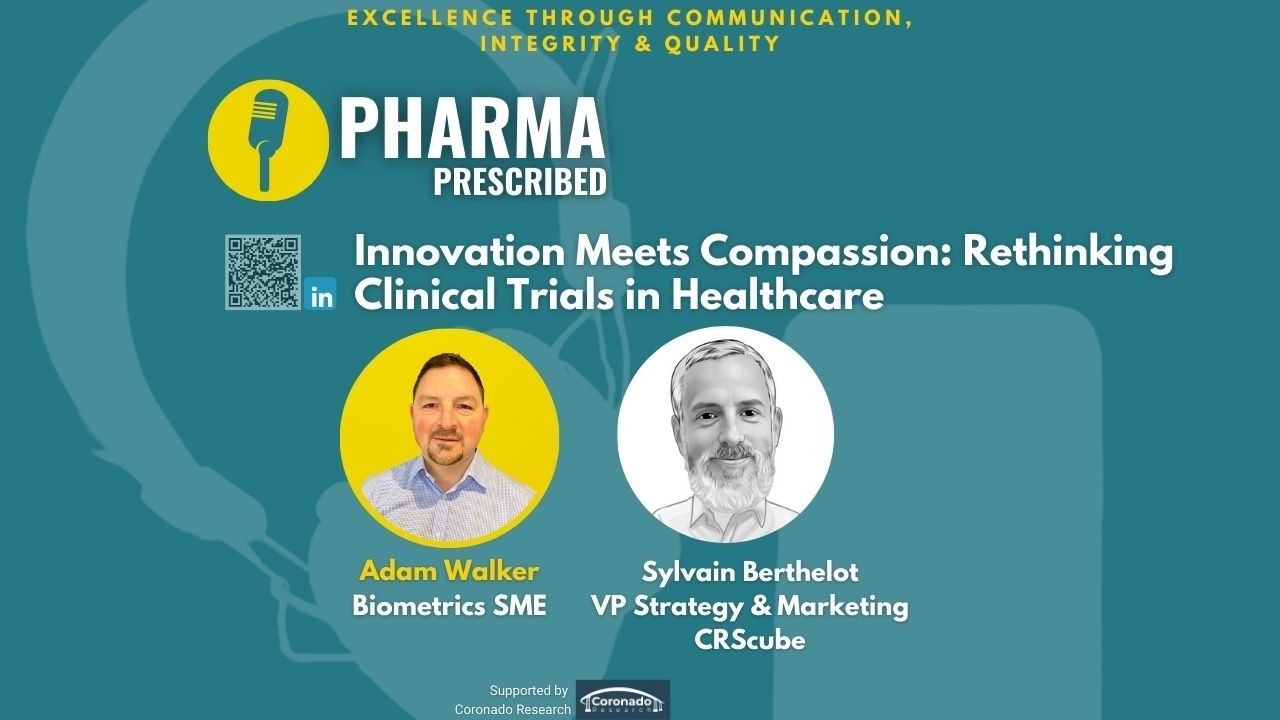
In this episode of the Pharma Prescribed Podcast, host Adam Walker sits down with Sylvain Berthelot, a clinical technology professional at CRS Cube, to discuss the intersection of human-centered design and clinical trial efficiency. Berthelot shares his unique mission to simplify trial execution, a goal driven by his dual roles as a technology expert and a podcast host who listens to the raw, personal stories of patients through his show, On One Condition. He addresses the industry's frequent use of the term 'patient-centricity' and contrasts it with the reality of clinical protocols that often overlook the human experience. The conversation dives deep into the cultural shifts required to modernize clinical research, specifically looking at how the Korean approach to innovation—characterized by rapid decision-making and a mindset of 'efficiency by design'—is being introduced to Western markets. Berthelot discusses the importance of reducing friction between sponsors, CROs, and sites, arguing that the industry must move toward a collaborative model rather than one based solely on billable effort. Listeners will gain insights into how technical platforms can serve the people behind the data, the value of 'failing fast' in technology development, and why listening to the end-user is the only way to achieve true continuous improvement.
Chapters
Approximate · derived from transcript
- 0:00Podcast Introduction
- 2:36Meet Sylvain Berthelot
- 5:12Sylvan's Mission and Industry Insights
- 7:49Mission Simplify Trials
- 10:25The Journey to Patient-Centric Clinical Trials
- 13:02Challenges and Innovations in Clinical Research
- 15:38CRS Cube: A New Approach to Clinical Trials
- 18:15Korean Culture and Speed
- 20:51Innovation and AI Mindset
- 23:27AI in Clinical Trials
- 26:04Future Jobs and Training
- 28:40Advice for the Next Generation in Clinical Research
- 31:17Understand Each Role
- 33:53Quick Fire Round: Personal Insights
- 36:30Conclusion and Final Thoughts
Key insights
The Korean Ethos of Speed and Efficiency
Sylvain explains that the Korean approach to development prioritizes efficiency and decisiveness, often making strategic pivots in weeks rather than months to avoid the stagnation common in Western bureaucracy.
Embracing Innovation Within Internal Teams
Innovation isn't just about the end product; it requires a company to embrace tools like AI internally to fuel faster development cycles and maintain a competitive edge in clinical technology.
Bridging the Patient-Centricity Gap
Sylvain highlights a disconnect where many clinical protocols fail to mention the patient's perspective, driving his mission to bring patient stories into the heart of industry conversations.
Simplifying Trials by Reducing Site Friction
The current CRO model often prioritizes the sponsor relationship because they 'pay the bill,' which can lead to friction and a lack of support for the clinical sites actually conducting the research.
Newsletter issue
Everyone says they want to simplify trials
Clinical technology specialist at CRS Cube on what it actually takes to make trials simpler, why sites and sponsors keep talking past each other, and the patient stories that keep him honest.
The written companion to this conversation with Sylvain Berthelot. Browse the newsletter archive
Loading preview…
Full transcript
Edited for readability. Speaker labels preserved. Click to collapse.Click to expand.
Full transcript
Edited for readability. Speaker labels preserved. Click to collapse.Click to expand.
Podcast Introduction
Adam Walker:I am Adam Walker, a biometrics consultant, and this is the Pharma Prescribed Podcast where leaders, innovators, and hidden voices in healthcare open up, no sound bites, no spin, just raw insight, one prescription at a time. In an industry driven by data protocols and pressure, we rarely pause to ask the human questions.
Adam Walker:What drives us? What breaks us and what truths live behind the titles we wear?
Meet Sylvain Berthelot
Adam Walker:Sylvain Berthelot is a clinical technology and life science professional with deep expertise in clinical systems and the digital ecosystem that supports modern clinical research. Having worked extensively with sponsors, CROs, and clinical teams, he understands how technology can either streamline or complicate the delivery of high quality compliant clinical trials.
Adam Walker:In 2024, he joined CRS Cube, a company whose mission aligns with his commitment to simplifying clinical trial execution through intuitive people centered technology. Alongside his work in clinical innovation, Silvain is an active voice in industry and patient centric conversations through podcast. He hosts Clinical Data Talks, a podcast that explores the challenges, innovations, and real world experiences shaping clinical data management and clinical operations.
Adam Walker:Sylvan also hosts on one condition, a human focused podcast that raises awareness about chronic health conditions by sharing personal stories, combining technical expertise with a strong human perspective. Sylvan is dedicated to bridging the gap between systems, data, and the people they ultimately serve.
Sylvan's Mission and Industry Insights
Adam Walker:It's a pleasure to welcome you to Pharma Prescribe today, Sylvan, for those of our audience who are not familiar with you, who are you and what is the mission you're on?
Sylvain Berthelot:Thank you. It's a pleasure as well.
Mission Simplify Trials
Sylvain Berthelot:It's interesting because thinking about the mission for me, there's the mission at work, but there's also the mission in life the mission at work.
Sylvain Berthelot:You've alluded to it in the nice introduction that you did. I really want to simplify the execution of clinical trials. Everyone is saying that, which makes it very tricky in a way when you actually mean it. And I'm glad that I had the opportunity to join CRSQ because I feel like we're on that path to make things simpler.
Sylvain Berthelot:Not only for people who buy our technology, but also for people who are actively using them, but not directly buying them like the sites and so on. Yeah, my, mission is really to make it simpler and together with that mission actually. It's also getting people to understand each other a bit more.
Sylvain Berthelot:That applies to life as well actually, because I think if everyone was to understand each other more and listen to others a bit better, then I think we'd be in a much better and nicer situation in the world in general. But as it's applied to clinical trials. I don't like frictions that I hear when you have sites that say that CROs are not really looking after them properly or not listening to them properly.
Sylvain Berthelot:In my podcast with online condition, I hear sometimes patients say I've been involved in clinical trials and I felt like the sponsor wasn't necessarily paying attention to what I was saying. Those frictions are detrimental to what we're trying to do. At the end of the day, I feel like we're in one of the most valuable industries in the world where day in, day out, we're trying to expand lifespan.
Sylvain Berthelot:We're trying to increase quality of life, and that needs to come from working together rather than working against each other.
Adam Walker:I couldn't agree with you more. And firstly, thank you for explaining that with respect to, the simplification of clinical trials, my sense is personally and professionally I'm sensing that there is something driving you far deeper because as I know only too well, there's a lot of effort that goes into one podcast.
Adam Walker:You are running two and you're doing an amazing job at doing that both professionally and. On a personal level, that's got to take a lot of effort and it's a heavy lift, but more importantly, there's something deeper driving you to understand what people are about and the challenges that they have with their specific medical conditions, and aligning that around how to get the best quality data outta these individuals who are challenged every single day.
Adam Walker:I think is phenomenally interesting, but also I'd love to know more about that.
The Journey to Patient-Centric Clinical Trials
Sylvain Berthelot:So it's interesting because I think the reason why I started on one condition initially was that I was frustrated. I kept hearing people say patient centricity. I could, I had an impression that people were actually doing the right thing, that it was going in the right direction. However at the time when I started, I probably saw 10 clinical protocols a week because of what I was doing at the time, and none of those protocols mentioned patients.
Sylvain Berthelot:You couldn't really tell why it was important to run this trial from the patient's point of view. And it's still the case nowadays, unfortunately. So I wanted to learn more. I wanted to be aligned in what I do at work with what. Patients live on a daily basis, and I felt that others in the industry would be in the same situation as me.
Sylvain Berthelot:So I started on one condition to really understand the patient's point of view. Be closer to the science in a way because patients know so much about the science when it comes to their own condition. And then I felt like it was bridging a gap between people in the industry and patients. To be honest, I don't know if it's bridging that gap, which, it's a frustration, but also I think there are fights that you can't win on your own. However, what it's done is that it's given a platform for people to share about their conditions. And for me, it's given me a sense of mission to raise awareness about as many conditions as possible.
Sylvain Berthelot:And it's led to amazing conversations, and it's incredible when you listen to those conversations, the resilience behind living with a rare disease, for example, not only from a patient point of view, but from a caregiver's point of view as well. It's incredible and sometimes you.
Sylvain Berthelot:Look for heroes maybe to give you a bit of a boost. I feel privileged that I get to talk to those heroes regularly and I'm always amazed by way they do always.
Adam Walker:Yeah. I agree with that sentiment entirely. And. Usually the understanding behind people's conditions does certainly drive motivation, and people are clearly very honest with you.
Adam Walker:They give their truth. They speak their day-to-day experiences with these life-changing conditions that many of us are very fortunate not to experience, and I'm sensing that really does connect with your daily purpose and mission.
Sylvain Berthelot:Yeah.
Challenges and Innovations in Clinical Research
Adam Walker:I know in 2024, you joined CRS Cube. You've worked in this industry for a long time.
Adam Walker:Have there been companies and roles that you've performed in the past that haven't necessarily aligned so closely as I'm sensing your current role does?
Sylvain Berthelot:That's a trick question.
Sylvain Berthelot:Interestingly, I don't think there have been. Because I don't think anyone joins our industry thinking I'm going to make things hard. However I was part of Parexel at some point. And, and I was at Parexel at the time when Jamie McDonald joined and he really had a positive impact on the company.
Sylvain Berthelot:But being part of a CRO, I could see some areas that may not be helpful for sites, for example. And that was difficult to see, to be honest. But I don't think it's specific to that company. I think it's just where our industry is that you have sponsors who are there to push the science.
Sylvain Berthelot:You have sites who are there to care for patients, and they want to bring the best treatment they can to their patients. The CROs in the middle, they are a resource. And I think because of the CRO model that we have at the moment, all based on effort I think they're in the middle. And they need to align with sponsors because sponsors pay the bill.
Sylvain Berthelot:And I think sometimes they need to align with sponsors more than they need to align with sites. But it's interesting 'cause I really don't see anyone in the industry thinking I'm not gonna do a good job or I'm going to make this process difficult. I think it's really the situation we're in at the moment.
Adam Walker:Yeah, it's an amazing point you make there because like you, having worked for CRO pharma tech companies, there is a level of autonomy that you have in certain organizations that you can never reach in others. For people with a number of years experience in this industry like us, dare I say it, I think we can be a little bit more intentional about the companies that we support and that we work alongside, but that comes with experience, doesn't it?
Adam Walker:You've got to find that way to weave through the weeds and the bureaucracy and some of the challenges and finding where that purpose meets your. Own individual objectives and
Sylvain Berthelot:yeah,
Adam Walker:That's certainly been the experience that I've had over many years. And as an independent consultant, I can't be choosy, but I can be intentional about the companies that I try and focus my attention around these days.
CRS Cube: A New Approach to Clinical Trials
Adam Walker:So tell me more about CRSQ, because whenever I see you at conferences. Not only do you have a big smile on your face, but you're always at the stand talking about their wonderful EDC systems and technology. I'd love to know a little bit more, and maybe our audience would like to know a little bit more about them, because my sense is you're doing things slightly differently.
Adam Walker:You're doing it with patients at the heart of what you're doing.
Adam Walker:And I don't think those are just words.
Sylvain Berthelot:No. You're making a very good point. No. C-R-S-Q-B, it's interesting because, you have so many vendors in the industry that do exactly the same in terms of product, but and I don't know if people can see, but I'm wearing my CRS cube top, and when I joined CRS Cube.
Sylvain Berthelot:I had the opportunity, like the first meeting I had was with our CEO Stanley Kim, and he was very open-minded. That was my first impression of him. He was eager to learn. I joined at a time when. The clear mission that he gave me and my manager who joined at around the same time as me was, we are excellent in Korea.
Sylvain Berthelot:We're doing very well in Japan. Now is the time when we want expand in Europe and in the us. And he gave us this mission of helping the company with this expansion. And to me that was the first excitement, which was, okay, let's do the same thing as others have done, but in reverse because a lot of vendors started in the US or Europe, then they getting traction and then they expanded into Asia.
Sylvain Berthelot:Let's do something. The other way around. So that, really made me want to join first. But then something I wasn't expecting actually was that it allowed me to understand the Korean culture more. And I, in awe of how people do things in Korea like truly. And I'm a honest person, so when I say that it's not marketing, it's really that the ethos behind work in Korea leads to efficiency by design in a way.
Sylvain Berthelot:And I think that for me is the biggest difference when I look at other vendors in the industry is that there's a constant exploration of how we can make things more efficient. And the platform started with an EDC. Now we have 10 different solutions on the same platform. But we're still investing in the EDC because there's still improvements, like data management can still be easier than what it is at the moment.
Sylvain Berthelot:So what I like as well about CRSQ is this search for continuous improvement by listening to, end users and. Something that really aligns with my mission is that when I say listening to end users, it's not only people who pay, but also people who use the platform. And at the end of last year, we did net Promoter Score surveys we started with CRCs and CRAs and then we did it with study teams.
Sylvain Berthelot:The feedback that we got is so positive that we know we're on the right track. So it's very comforting in a way. But then when I look at my colleagues who are in charge of product, they're not focusing on the positive. They're focusing on what can we do better? And I love that.
Adam Walker:Thank you for sharing
Adam Walker:that really just gives an insight into. The cultural alignment.
Korean Culture and Speed
Adam Walker:I'd love to understand a little bit more around that, the Korean mindset in developing technology, because that's not something that I'm familiar with, I don't think many of our audience will be familiar with. How does that translate into UK, Europe, us?
Adam Walker:Because the first thing I immediately am thinking about is the fact that they have a very different alphabet. I think I'm right in saying
Sylvain Berthelot:Yeah. Yeah.
Adam Walker:So whatever has been done initially, presumably was done in Korean and the local languages and has been translated into what we would recognize as our alphabet here.
Sylvain Berthelot:Yes, that's a good point. There's a interesting story about the alphabet actually, because korea in the past was using traditional Chinese but then one day the king at the time king Ji. Decided that to build a sense of culture but also to help everyone in Korea be able to learn the language, be able to read, be able to study.
Sylvain Berthelot:He decided to create the Korean language. And that's something that translates into the Korean culture even now because there is this intention of doing things for others. And that's not only at CRSQ, but it's across the country from what I can see. But in terms of how Koreans, from what I see work it's all based on being efficient in what you do.
Sylvain Berthelot:And one of the aspect that I found difficult to adapt to, to be honest, to start with was the speed at which they do things. And that speed translated into challenging how I did things very quickly. When I joined my recommendation was that we needed to tweak the branding. Which turned into a complete rebranding.
Sylvain Berthelot:We, keep the name, but then most of what was around that name changed. And I can't remember what I had in mind at the time, but I had an expectation that this would take a few months. And Stanley, our CEO gave me a few weeks. It was challenging because I wasn't expecting that and I was used to work in companies where you would study what you are about to do, you would collect data, you would ask around and then the decision making would be very slow.
Sylvain Berthelot:The decision making at CRSQ at least, is so fast. And when we were going through that rebranding process I was expecting Stanley to take time to, think about what I was presenting to him because part of it was shaping the voice of the company, how we would present it to western countries. No, he used to, he made decisions in hours.
Sylvain Berthelot:Sometimes he made decisions during meetings when he was seeing things for the first time, and that's incredible. And that really helps move a lot faster than what I see from other companies.
Adam Walker:I think that's a really refreshing insight. It speaks to. The point around technology and innovation where I know many tech companies pride themselves on failing fast and falling forward.
Sylvain Berthelot:Yeah.
Adam Walker:Namely, it's better to make a decision than to sit on something for nine months during which time your opportunity's gone.
Sylvain Berthelot:Yeah.
Adam Walker:Opportunity for change and bringing people along with you for the ride has gone as well. And in many organizations, those that. Are innovative and decisive in the decision making, tend to follow through with these things a lot quicker.
Tech innovation. You've talked about the 10 or so other different bolt-on services around CRS Cube. I think that really speaks to that point that I understand the. Nuance around getting things done. That sounds like a very powerful message to send out to our audience particularly.
Sylvain Berthelot:Yeah, definitely.
Innovation and AI Mindset
Sylvain Berthelot:And it doesn't mean that the decision is right, and especially when you talk about product development, there are things that may not make it to the end product. But it's better to try and fail than wait until it's too late to actually go into that direction.
Sylvain Berthelot:What I find interesting is that even when you try and fail, I think you're successful because there's always a learning from that. Which I find very interesting.
Adam Walker:Just on that point, there's two particular things that I wanted to say. Failure is data acquisition,, And secondly, better to be 51% certain of an outcome and go forward with it than wait till you're 99% certain and then go forward with it.
Adam Walker:Sorry.
Sylvain Berthelot:Yeah,
Adam Walker:please continue.
Sylvain Berthelot:No, I agree with that. But what I really like as well is that sometimes in a development or product development company, so you push innovation to your clients, but you don't necessarily embrace innovation yourself. But what I'm seeing from our product development team is that they are embracing AI in their daily routine now,
Sylvain Berthelot:which is something that brings more fuel to what we're doing for our clients. And I think I've seen in the past companies that tried to be innovative but didn't necessarily invest in their own team to allow them to be as innovative as they could be in terms of tooling or processes.
Sylvain Berthelot:And I think that if your company itself. Is not embracing innovation. It makes building innovative products very difficult.
Adam Walker:Yes,
Sylvain Berthelot:because then you, start falling behind. And also I think there's a key message that needs to come from top to the bottom of the company, which is the future of, the industry, the future of data management is with AI now let's embrace AI in our daily routine, and then that will help bring that to our clients.
AI in Clinical Trials
Adam Walker:You've touched on it, so let's go down that rabbit hole. With regards to ai, obviously it's the hot topic. It comes up time and time again in the conversations that I'm having, and I'm sure it comes up in the podcast that you are hosting as well.
Adam Walker:I'd love to know your perspective on how it's being implemented within CRS Cube and around some of the sponsors and companies that you're working with, because everyone's talking about it. We are now in an age when not just, it's in the palm of our hands. It's accessible, it's cost effective.
Adam Walker:I've seen some incredible demos in the last year or so where it's been implemented onto those clinical systems.
Adam Walker:And many companies are embracing that. I'd love to know from a tech point of view, your perspective on it and what you're seeing and how that's being incorporated into the offering that you have.
Sylvain Berthelot:So looking at the industry to start with, how it's implemented, I feel like sometimes it's being implemented without intention. And I've seen some ideas around ais that were very good, but that didn't stand a chance because they had no goal attached to it. And. What I like about what we're doing at CRSQ is that we start with a need rather than starting with say, let's do some data mining and then we'll see what comes out of the wash, because I don't think that leads to anything.
Sylvain Berthelot:So we actually started with AI relatively, I'd say. Simply, I'm pretty sure my, colleagues in Korea would say, no, it wasn't that simple. But we had very specific ideas about where we wanted to implement ai. So we started with AI medical coding. We then also did a, aI chat bot to make it easier to find answers from our online user documentation.
Sylvain Berthelot:So these were things that were not groundbreaking. But they were successful because they had the right goal in mind to start with. Now we're working on things that are much more groundbreaking. And I really like what we're doing. I'm not necessarily allowed to talk about it,
Sylvain Berthelot:but I think what it will bring is much more efficiency and also much higher quality of system setup. Which will hopefully lead to more time for key roles in the clinical trial execution to. Actually look at data rather than building what's needed to be able to see that data. So I really like that.
Sylvain Berthelot:And what I'm seeing is extremely promising.
Adam Walker:That's great to hear. That really is, but do continue.
Sylvain Berthelot:What I'm a bit worried about, if I'm honest, is that I don't know if the industry is quite ready yet. Going back to what I mentioned earlier, we've got an industry that's very stuck in the way we work.
Sylvain Berthelot:And if we reduce as an example, EDC setup down to, I don't know, less than a week. How is the industry going to react to that? And I can think that there will be people who embrace that and who will go, okay, let's move on with this innovation and adapt how we work. But there may also be some companies or types of companies.
Sylvain Berthelot:Who are not ready to reduce the effort it takes to build an NDC because effort equates money.
Adam Walker:You're right, the systems and processes are long established. Anyone working in this industry for any length of time will know that. And when you mentioned around, a database for a clinical trial being set up in a week.
Adam Walker:I immediately thought, that kind of puts people like me out of a job. But also what I would say is a lot of the time, particularly in CROs, is spent in those handoffs, isn't it? It's where you have peer review, you start with a junior member, it goes to a more senior person, and then ultimately maybe it goes out to the sponsor and they have their cycles for their reviews of documentation and database builds.
Adam Walker:And that's the first part. I've also seen other companies that are building EDC straight from a protocol. So literally pushing protocol to EDC, electronic data capture tools. There are different ways to slice and dice these things. Ultimately, we have to remember what this is about. We started talking about patients.
Sylvain Berthelot:Yeah.
Adam Walker:Let's remember what this is about. It's about getting drugs into patients as quickly as possible, as safely as possible with the due diligence. We've got tools at our disposal now or very soon to have, once they're tested and once they're tried and fully validated, that ultimately should make the patient's experience far better, shouldn't it?
Sylvain Berthelot:Yeah.
Adam Walker:That's got to be the goal.
Sylvain Berthelot:Yes, I agree with you. And I've looked into aI applied to patients actually. How it could make things a bit easier but also how it could bridge that maybe gap that may exist sometimes. On the human side. For example, there could be an application where AI is used to tailor messaging to your audience.
Sylvain Berthelot:If you have a study with patients in their twenties, but also patients in their fifties, sixties, the way you want to engage with those patients should be. Different because they have different expectations. They're in a completely different position in life. And AI could help with that because like tone of voice ways of explaining things.
Sylvain Berthelot:AI can do that. It can really adapt to who you are talking to. The human in me thinks we can't get AI to make us appear more human. It doesn't make sense. But then I'm wondering if that's something that we should consider.
Sylvain Berthelot:I see.
Adam Walker:Thinking I, I really am thinking.
Future Jobs and Training
Adam Walker:I was listening to something the other day in which, a footballer was talking about how when he learned to play football 20 years ago, he learned from people who are now 60. Let's talk about that. The people that we learned from are another 20 years on from us.
Adam Walker:So what we thought was groundbreaking 20 years ago in our current headspace and with our learning and experience is actually effectively 30, 40 years. Isn't it?
Adam Walker:So we need to put ourselves outside of this and really looking in from the next generation and generations beyond and saying, what can we do?
Adam Walker:What can we leave by the door around Experience, ego learning and that transitional state of passing the. Opportunity to the next generation, because effectively, like I said, it really made me think when I was listening to that the other day, I thought, wow, there is a point to that, isn't that?
Adam Walker:And that's,
Sylvain Berthelot:yeah,
Adam Walker:Wisdom has a place learning and education obviously is pivotal to that as well. But there are a lot of very talented young people coming into this industry, many of whom listen, I know, to this podcast who will be asking those same questions. They're like, yeah, but what's this mean for me?
Adam Walker:If I'm newly graduated from university now, let's say with a biomedical or a technical degree, what roles, what opportunities are there and what do I need to know and understand in order to succeed today?
Advice for the Next Generation in Clinical Research
Adam Walker:Do you have the answer for that?
Sylvain Berthelot:I don't. I don't think so. And I don't think anyone has the answer yet, because especially in our industry.
Sylvain Berthelot:We haven't defined those rules of adapting to ai. And also I think something that's slowing us down a bit in the industry is that everyone is making their own rules. And that's true for sponsors, s sites that instead of relying on some standards or, trying to work together on a common approach.
Sylvain Berthelot:Everyone is looking into it separately and defining, okay, how are we going to adapt to it? But I think the key part that we are missing, if you are thinking about the next generation who's going to come in five to 10 years, and at those. I don't like the term, but those entry level jobs currently, I think the biggest gap probably is that they're not being trained on what the tools will be like in five to 10 years because those tools have not been released yet.
Adam Walker:Yeah.
Sylvain Berthelot:And on top of that, we work in a, in an industry that's very specific and I think we're lacking the right training or the right study courses for people to enter our industry, knowing what they're going to be doing. There's so much of a learning curve when you start. In the clinical trials industry, that you have to rely on those people who have been here 20 to 40 years to know to really understand what you're doing.
Sylvain Berthelot:And it's interesting 'cause my first five years in my career I worked in preclinical. Preclinical I knew I was aware of the clinical trials space but it felt like such a massive gap that at the time for me, it felt an achievable. I didn't know how I could move from preclinical to clinical.
Sylvain Berthelot:So if you're thinking of someone who is coming out of uni. Who has a very little understanding of the clinical trial space. It must be even worse. Very difficult.
Adam Walker:Yeah, it's tricky. There are plenty of young graduates that I'm supporting at my alumni and these are very similar conversations that I'm having with them as well.
Adam Walker:They're questions that they're asking, but also it's a very difficult industry to break into. Yeah. The first opportunity is usually the one that will define you for the next chunk of time.
Adam Walker:It's getting your foot in the door. That seems to be the hardest thing at the moment. We've touched on so many fascinating areas.
Adam Walker:Is there anything that we haven't touched on so far that you wanted to elaborate on further? Because I think there are so many interesting areas that are whizzing around my head right now, but I'd love to give you the opportunity.
Understand Each Role
Sylvain Berthelot:I think what I would say is that
Sylvain Berthelot:I think people should really try to understand what others in the industry do. Better. There are so many roles that are key to the execution of a clinical trial, but those roles are so specific that even if you are close to it, you may not know exactly what they're doing. It goes back to what I said earlier about understanding, I think knowing what A CRA does on a daily basis.
Sylvain Berthelot:Even if you are not aiming to, do that job yourself can be interesting and can help you understand what we do in the industry better. And I think that's true for a lot of the roles, a lot of the actors of clinical trials. What does a biostat do? How do they interact with data managers? I think like really trying to learn from others who are in those jobs.
Sylvain Berthelot:I would say it is one of the best ways to try to understand where there may be gaps, where there may be frictions and how to solve those problems.
Adam Walker:Thank you for elaborating on that. I think that's rich insight that you provide there.
Quick Fire Round: Personal Insights
Adam Walker:At this point in the conversation, I always like to finish with a quick fire around Sylvan.
Adam Walker:So what is the one piece of advice you would give to your younger self?
Sylvain Berthelot:So this one is interesting. I would say pay attention to the dynamics.
Sylvain Berthelot:I need to elaborate. I know you can know your job very well. You can know what you're doing, but if you don't understand the dynamics of the company you work for or the environment you are in, you may not achieve what you want to achieve. And I think when I started, I was oblivious to that. I started in a very small company.
Sylvain Berthelot:I think we were 25 in total. So it was a bit of everyone does their job and more or less, everyone talks to the CEO on a daily basis. When you join bigger companies, that's where you really need to understand the interactions. Who's influential, who isn't, if you want to get to where you want to be.
Adam Walker:Great perspective. Thank you for sharing. What are the top three qualities you value most when building a team?
Sylvain Berthelot:For me what I like seeing is honesty to start with, and the second one is open communication. I think those two come together, and at least from my point of view, if you don't get those in within your team, then you're going to have issues moving forward.
Sylvain Berthelot:And then the third one is accountability. I make mistakes. Everyone make mistakes. As long as you own those mistakes and you learn from it, then it's not necessarily a failure. But if you avoid. Talking about those mistakes or if you don't own them, then well, you are not necessarily honest to, others and to yourself.
Adam Walker:I appreciate you sharing that. Thank you. What is your favorite thing outside of work?
Sylvain Berthelot:My family to start with. I have a wonderful family, two daughters, and they're my rock. Without them I don't think I would be myself. But then I love being outdoors as well, so I do a lot of running hiking, surfing, and all of these.
Sylvain Berthelot:You get to fight against the elements, and that's refreshing. That gives me a bit of time to think or not think at all three.
Adam Walker:As I mentioned to you before we started recording, you live in a place which is very close to my heart. I visit there at least three or four times a year, and for anyone listening, that's a beautiful part of Devon, where you live, and I.
Adam Walker:Absolutely adore it as much as you must love living there.
Sylvain Berthelot:Yeah. It's amazing. We've got hills beaches at our doorstep. I can literally, if I run five minutes, I get in the middle of nowhere and I hear owls. Sometimes I can spot foxes and yeah it's amazing. I love nature.
Adam Walker:Wonderful. And finally, what is your number one golden rule in life and in business?
Sylvain Berthelot:So it doesn't really apply necessarily very well in business, which is a shame, but it's being nice.
Sylvain Berthelot:I like being nice. And sometimes I wish everyone had the same rule and I feel like life would be simpler.
Adam Walker:That's wonderful.
Conclusion and Final Thoughts
Adam Walker:We've had a really far reaching conversation today, Sylvan, we've touched on culture. We've talked about your mission, your personal, your professional mission. In addition to giving some really deep and rich insights and compelling views around the implementation of AI for the next generation.
Adam Walker:For any of our audience, if they want to reach out to you, what's the best way of making contact with you?
Sylvain Berthelot:So they can go onto the on one condition website. That's my patient advocacy podcast and they'll find my email address there. Yeah, I think that's probably the easiest way or connect with me on LinkedIn as well.
Sylvain Berthelot:I use LinkedIn on a daily basis.
Adam Walker:That's very good. I also want to say you have inspired me. Many times, and you are one of the reasons why I picked up a podcasting microphone because I saw that other people were doing it. And that told me that there was an opportunity to not just follow in someone else's footsteps, but also just create a voice of oneself that, in our industry, it's very difficult to stand out, but it's also very difficult to do something with purpose and meaning that can touch people.
Adam Walker:And this is a means by which you do it and I do it. And I want to just, reinforce what a wonderful job I think you're doing both professionally and personally on both the podcasts that you are leading with incredible conviction. And I just want to congratulate you on those because they're great and you are leading with kindness.
Adam Walker:And I don't know how that equates back to your qualities of honesty, openness, and accountability, but. It's a pleasure to know you both in person and professionally. So keep doing what you're doing 'cause I can't thank you enough and I just want to thank you for being on Pharma Prescribed Today, Sylvan.
Sylvain Berthelot:Oh, thank you. I really appreciate that. And thank you for the opportunity. It was a pleasure.