Healthcare Systems · Episode
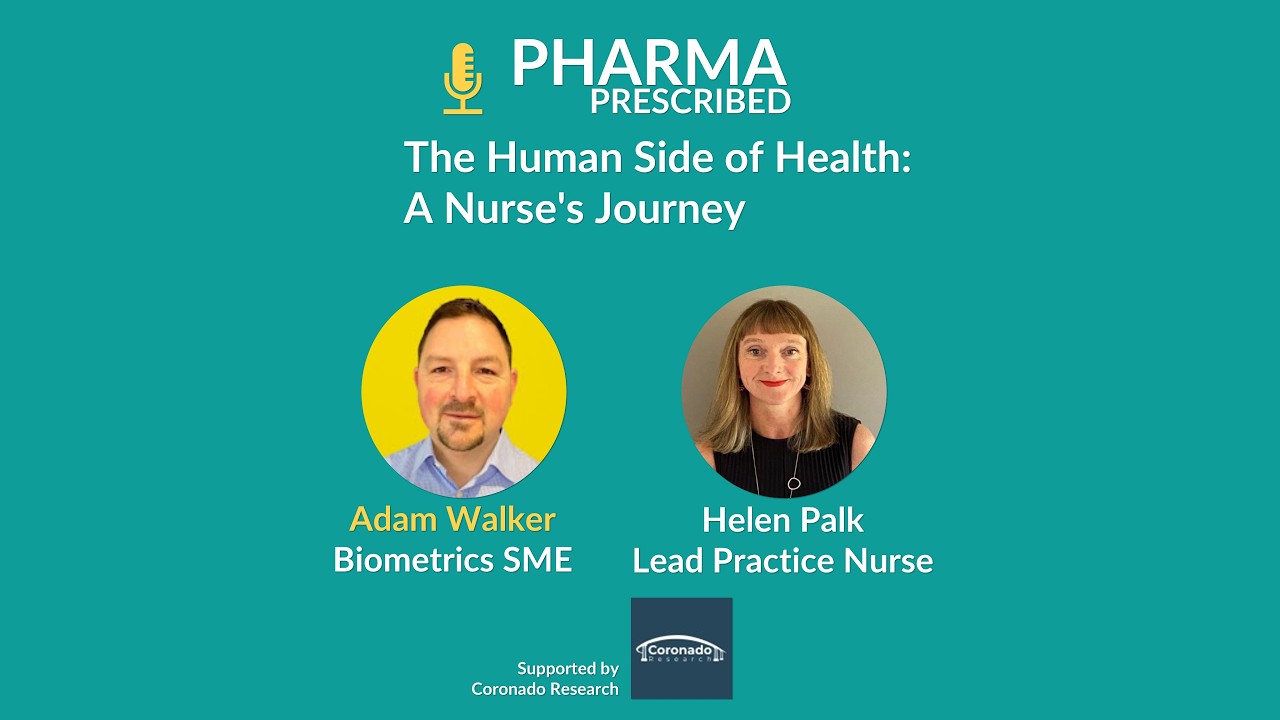
Helen Palk — 30 Years of NHS Nursing, COVID Vaccines & Human Side of Healthcare
In this episode of Pharma Prescribed, host Adam Walker sits down with Helen Palk, a veteran nurse whose career spans nearly three decades of service within the National Health Service. Deeply influenced by the legacy of her grandmother, an army nurse during the Second World War, Helen shares the journey that took her from the pharmacy counter to the front lines of general practice and midwifery. This conversation goes beyond the clinical protocols to explore the human heartbeat of healthcare, focusing on Helen’s mission to preserve "old-fashioned" bedside nursing in an increasingly digitized and data-driven industry. The discussion delves into the grueling realities of 1990s nurse training, the emotional and physical demands of the labor ward, and the critical importance of patient consent and intimacy in general practice. Helen provides a candid look at the challenges modern nurses face, from the pressures of revalidation and continuous professional development to the paradox of staffing shortages despite the influx of newly qualified graduates. Listeners will gain a rare, behind-the-scenes perspective on the resilience required to maintain a compassionate bedside manner across a lifelong career and why the human connection remains the most vital prescription in any clinical setting.
Chapters
Approximate · derived from transcript
- 0:00Welcome to Pharma Prescribed: Human Questions in Healthcare
- 2:13Meet Helen Palk: From Pharmacy Counter to Nursing Calling
- 4:27Helen's Mission: Bringing Back Old-Fashioned Bedside Nursing
- 6:41Midwifery Path
- 8:55Midwifery Realities
- 11:09Finding General Practice
- 13:23Consent in Practice
- 15:37Volunteering to Vaccinate
- 17:51Team Bonds and Gratitude
- 20:05Working with Milo
- 22:19Future of the NHS
- 24:33Teamwork and Purpose
- 26:47Animals and Joy
- 29:01Golden Rule and Farewell
- 31:15Final Thanks & Closing Reflections on Service
Key insights
Life Experience Shapes Clinical Confidence in Midwifery
Reflecting on her early years in midwifery, Helen notes that being a younger, less experienced clinician impacted her confidence in high-pressure delivery environments, suggesting that life experience as a parent can be a valuable asset in the field.
The Challenge of Entry-Level Healthcare Vacancies
Despite the ongoing staffing shortages in healthcare, Helen highlights the paradoxical struggle that newly qualified midwives face when trying to secure institutional positions after graduation.
The Therapeutic Power of "Old-Fashioned" Bedside Manner
Helen views a clinician’s smile and warmth not just as a courtesy, but as an essential tool for de-escalating patient anxiety and facilitating cooperation during intimate or invasive medical procedures.
Practical Experience Outweighs Theoretical Training in Nursing
While formal education and CPD are mandatory, Helen emphasizes that nursing remains a fundamentally hands-on discipline where true competence is earned through repetitive ward practice rather than just study days.
Newsletter issue
Give patients time, not tick boxes
A nurse of nearly thirty years on the grandmother who set her on the path, the vanishing art of bedside nursing, and why proper care can't be reduced to a checklist.
The written companion to this conversation with Helen Palk. Browse the newsletter archive
Loading preview…
Full transcript
Edited for readability. Speaker labels preserved. Click to collapse.Click to expand.
Full transcript
Edited for readability. Speaker labels preserved. Click to collapse.Click to expand.
Welcome to Pharma Prescribed: Human Questions in Healthcare
Adam Walker:I'm Adam Walker, a biometrics consultant, and this is the Pharma prescribed podcast. Where leaders, innovators, and hidden voices in healthcare open up, no sound bites, no spin. Just raw insight, one prescription at a time. In an industry driven by data protocols and pressure, we rarely pause to ask the human questions.
Adam Walker:What drives us, what breaks us, and what truths lived behind the titles we were.
Meet Helen Palk: From Pharmacy Counter to Nursing Calling
Adam Walker:Today we're joined by Helen Palk, a nurse whose career was shaped long before she ever stepped onto ward. Inspired by her grandmother, an army nurse caring for injured troops. During the Second World War. Helen grew up surrounded by strong, compassionate women in healthcare.
Adam Walker:Her path began behind the pharmacy counter working weekends, later qualifying as a pharmacy technician. But Helen wanted to be closer to patients and a role as a healthcare assistant on Chichester Ward at the rural Sussex County Hospital opened her eyes to the world of nursing. Encouraged by colleagues.
Adam Walker:She completed her registered general nurse training, working across urology, theater recovery, and later progressing into registered midwife training. For the last nearly 30 years, Helena served as a general practice lead nurse in the southeast of the uk, a role that draws on every skill she's earned. A story is a testament to the dedication, adaptability, and a lifelong commitment to the National Health Service.
Adam Walker:I'm honored to call Helen a friend and I'm delighted to welcome her on Pharma Prescribed Today.
Helen's Mission: Bringing Back Old-Fashioned Bedside Nursing
Adam Walker:Helen, for those of our audience who are not familiar with you, what is the mission you are on?
Helen Palk:Thank you Adam. Nice to see you again. I've been very fortunate with my career as you've just explained, and I would say my mission would be, might sound corny to carry on as I started.
Helen Palk:The old fashioned nursing, the matrons as I learned from my days on the wards from my family grandmother, the stories I was told, I think we need to remember what nursing is about. Things have changed so much over the years, so my mission, I would say would be. Let's carry on old fashioned nursing bedside, proper patient care, talking to patients, giving them time.
Helen Palk:It's not about tick boxes, unfortunately. NHS it is a bit now, yeah, that's my mission. If we can just, let's get the new nurses to train as we did. That's what I would say.
Adam Walker:That's a lovely principle and a really lovely place to start.
Adam Walker:So it sounds like your grandmother did really inspire you from a very early age.
Helen Palk:Absolutely.
Adam Walker:And set that grounding.
Helen Palk:Yes. Yes, she did. She lived with us. Sadly her marriage broke down and she moved into the family home, so she was like a second mother. We had a very close bond and she would always say, love you to do nursing. Obviously when I was younger, I wasn't sure that was for me.
Helen Palk:As we don't know what we're going to do when we're young and growing up. But she always said it would suit me. She just could see it in myself and my sister, who's a nurse. Also, we were very fortunate, as you just explained, my journey to actually be accepted for the training. 'cause back in the 1990s it was very hard.
Helen Palk:Not now, but it was very hard to get a place as a trainee nurse, RGN, registered nurse, registered midwife. You could be waiting. About a year for a place. It was a very popular sort of job to go to in training. And yes I was very fortunate how my life's turned out. So I'm very grateful.
Adam Walker:From the outset.
Adam Walker:When you started in nursing, you've done all sorts of different areas, haven't you? You mentioned about having supported in a pharmacy as well as having qualified as a midwife.
Midwifery Path
Adam Walker:I'd love to hear more about your time as a midwife and how that came about.
Helen Palk:Yes. With midwifery, there's two roots into becoming a midwife.
Helen Palk:You can either go straight to do your midwifery training. And that would be your three year training as your general nursing is. But fortunately, there are courses once you've qualified it, either you can go on for another 18 months to do further training. And what I wanted to do was try my nursing. I think it's good to have a background, get my training done, see if it suits me, see if I'm.
Helen Palk:Good at the job and I did enjoy it. Great deal. And I worked, as you said, in recovery, met some lovely colleagues that I'm still very good friends with now, and urology was very interesting. But I wanted something more to try something else and I, again, was very fortunate to apply and was accepted for my midwifery training.
Helen Palk:That was the 18 months. Did that, that lasted about, I think at about three years for that, once I qualified, but I was drawn. Back to general nursing. I kept up to date. I kept my practice relevant and I did practice on the wards with the midwifery, and that's where I am today. But midwifery was exciting, but scary.
Helen Palk:I was young. I hadn't had children myself and I'd be honest, it put me off a little bit. Of having children because I was at a young age, vulnerable, saw some sights didn't feel confident. And I think looking back, I don't regret it in any way, but I think if I was to do it now, being a mother, I would have more confidence.
Helen Palk:But I'm glad I did what I did and again, wish free. Was an amazing area to go to. The midwives, they're amazing people. They worked so hard and very long hours with little support. Really, they have to run the label boards themselves and. I think it's a scary place to work if your confidence isn't a hundred percent, which it wouldn't be in your twenties.
Helen Palk:You're quite young. You are learning life, aren't you? You are learning as you go, but amazing job, amazing opportunity to deliver. You have to deliver. At the time I trained a hundred babies to qualify. So you keep a record and I still have a record somewhere of all the babies that I delivered.
Helen Palk:And I was named in the paper a couple of times. I've got some paper articles of some clips of people that were very lovely, that thanked me and one named a baby after me, which was amazing. So that little girl must be about, gosh, 30 old now. So it's lovely. It is a lovely job. But obviously everything's lovely when it goes well.
Helen Palk:That's the thing.
Adam Walker:Yeah. Yeah.
Midwifery Realities
Adam Walker:You mentioned about the fact that you were very young when you went into midwifery and I think that's a really key point, isn't it? Because I know several people who've qualified later in their careers, once they've had their own families. I can only imagine your perspective would've been very different before you had your own family.
Adam Walker:Yes. Not least of all, the physicality of giving birth, but also I know the extended hours. It's not an eight hour shift, is it? If a baby's pushing in the seventh or eighth hour of your shift, you're there until, you don't go until it finishes.
Helen Palk:Yeah, exactly. It's not an nine to five job.
Helen Palk:Exactly. You say, Adam, once you are with. Lady in labor ward, you cannot leave them. You don't want to leave them. Even if someone comes and offers to take over, that lady has bonded with you and you stay to the end and you want to see the outcome. So you could go in for your eight hour shift, but you are there 15 hours.
Helen Palk:But you still have to be on duty the next day. I remember the times that I'd go home in my old mini that used to break down all the time on the way home with sort of four hours sleep because you're called back in again. I dunno, things have changed much. Probably not over the years, but it was a, tough job for all of us.
Helen Palk:Yeah.
Adam Walker:Dare I say, I think it's probably only got harder because the demands on healthcare certainly in the UK have. Increased. And I think to your earlier point, you know there is a real. Demand for qualified nurses in the UK is, they're not.
Helen Palk:There are, and then on the news yesterday I heard it's shocking that I have a friend that's daughters just qualifies.
Helen Palk:A midwife not in the air I'm in and can't find a job. I'm shocked. And they were saying actually on the radio yesterday how the governments are gonna fund more positions, but newly qualified midwives cannot be imp, which is ridiculous. The shortage, I don't understand why they're not enough vacancies.
Helen Palk:What,
Adam Walker:but
Helen Palk:it just doesn't make sense, does it?
Adam Walker:There I say babies will always be born. Yes. And they will always need to be delivered.
Adam Walker:I'm wondering what did you learn most about yourself during that time? Because you were young as you said. And it was early on in your career.
Helen Palk:It was. I had a very unfortunate experience, which did, make me change my mind was this for me or should I go back to the nursing? The outcome turned out fine. Lovely mother and baby, but unfortunately it was an emergency situation and things happened. As I say, I felt very sad and my colleague who was supporting me at the time, we worked together, I was still
Helen Palk:training and I nearly gave up and thought, this is me. But I thought, no, I've come so far. And I was encouraged to carry on and everything was fine, but I was fortunate. I only had one, one incident that's happened out of our hands, completely just short staffed. Patient wasn't monitored enough. It happens every day.
Helen Palk:I'm sure still fortunate as the same mother and baby survive, but it might have been a different story. Although it wasn't anything to do with myself, but it was some of us assigned to look after with the many others that night, and we were just so short on staff and.
Helen Palk:That's where the danger happens. So that's why I did really evaluate what I was doing, but carried on my training, carried on working, and then I felt no nursing's for me. So it was a lovely opportunity I was given and I'm really grateful I qualified, but I feel I did the right thing,
Adam Walker:We are a long time in a career, are we not? And all these experiences make us and shape us and form us. And clearly the experience you had in midwifery determined what you wanted to do in the future. And as I said, your caring nature runs through everything that you do. You subsequently had your own family and you've got two sons Yes.
Adam Walker:Who are an absolute credit to you and your husband.
Helen Palk:No
Adam Walker:thank you.
Finding General Practice
Adam Walker:then you moved into general nursing. Tell me more about that, if you would.
Helen Palk:As I said, my background was nursing already and so I, was very fortunate that I'd actually carried on. My registration was up to date and I found a job in a general practice and I went on for an interview and I just finished the midwifery.
Helen Palk:I just was going to leave midwifery and I wasn't sure. The nurse that interviewed me, I just explained my background. Said, we'll give you a try. And it just went so well and I just knew from day one. This is definitely for me, the variety of my job, the people you meet, the people you work with, good and bad.
Helen Palk:My confidence has grown over the years. Obviously at beginning I was nervous. As we all ask junior nurses and you look up to your superiors. But the way I look at it, and I was treated so kindly by everyone I've worked with I haven't really touched with in my career, had any major problems at all.
Helen Palk:Some people have, and I do think attitude helps. You have to expect that if you're working underneath a more senior nurse, you need to expect them. But you learn with as time goes on, you grow as I say, your confidence with your relationships with work. I like the variety.
Helen Palk:No two days are the same. And my colleagues we laugh together. We say it's. It's almost a bit like we, we've never been actors, any of us, but you want, if actings like this, 'cause sometimes you go into work, you have a smile on your face from morning to evening and inside you might not want to be smiling, but you have to because you want to make your patients feel better.
Helen Palk:They've come feeling unwell. You want 'em to go away feeling better emotionally and physically if you can do both, and that's the aim of the game. I think with our job, we would all say,
Adam Walker:Yeah I think you've really hit on something there and also the other thing that came to mind when you were talking about that is the intimacy with which you perform your role.
Helen Palk:Oh,
Adam Walker:yes. Yeah. That, are highly specialized, that involve very intimate parts of people's bodies. But also you're drawing bloods. You're doing various other activities with people. Yes.
Helen Palk:Yeah.
Adam Walker:I don't know how you do that on a daily basis and leave. Leave yourself at the door and then bring your whole self to work.
Adam Walker:How does that play out for you?
Helen Palk:It's interesting. Because I've done it for so long, maybe at the beginning, I'm sure I was nervous. I'm sure I was, and I still have days where I'd probably look at my list and think, oh my goodness, this is gonna be a tough day, but. Every time someone comes in the room and whatever mood they're in, I think I, really want to try and change this around if they're not feeling happy, not being perfect, but just trying to, it'll make it easy for both of us.
Helen Palk:Let's start off being friendly. Let's start off with a smile. It will put someone at ease straight away, and then you always have to ask consent as any nurse would. And if somebody's really nervous and really doesn't want a procedure done, you don't do it. It's simple as that. It's up to the individual to decide how much they want done that day, et cetera.
Helen Palk:But I must say I do work with a fantastic team that all get good results, we do our best. And I do think that we are all human. We all have the same body parts we say to each other, w if somebody's nervous or upset or embarrassed, I'll try to put 'em at ease and say it's your decision, if we can try it this way.
Helen Palk:And then normally that does tend to work and it's nice to see a patient leaving the room and actually shake your hand sometimes and say, thank you. That was so much easy and I thought it was gonna be, as I say, and it's just a nice feeling.
Adam Walker:Yeah, dare I say, having been on the receiving end of plenty of.
Adam Walker:Blood draws and various other procedures. Myself, it does make a difference, the smile and the warmth with which you're greeted, whether that be by a doctor or a nurse. You also touched upon consent and patient wellbeing. Really, as far as I was hearing. In clinical research more generally.
Adam Walker:This is the principle that comes to mind a lot. We always put patient safety and patient wellbeing.
Helen Palk:Yes.
Adam Walker:And they consent at the center of every aspect of a clinical trial.
Consent in Practice
Adam Walker:Tell me, how does that translate into general practice for you?
Helen Palk:Of course I always think consent starts when the patient enters the surgery.
Helen Palk:They're Consenting coming to the building. So that's your first start. I always feel. This is the first port call. You can't drag somebody into the surgery. You shouldn't. And I do get patients that come in very nervous, young children with their parents for whatever vaccines or examinations, and I talk to them as an adult.
Helen Palk:Obviously of a certain age. If they're babies, it's different. But if they're, from 12 upwards, you do treat, you look at them in the face, you try and get some sort of understanding where they're at. Obviously talking to the parents. But a lot of consent is down to if somebody's, we call it gillick competent, so they're understanding the procedure.
Helen Palk:We are happy to proceed then. That's consent. And obviously we, and documentation now is such a big part of my job because you can unfortunately have some people that may say that they haven't said whatever and they have, so we've got to protect ourselves as well as clinicians. It can go both ways.
Adam Walker:Yeah, and I think around that particular area as well. I understand that you have continuous, ongoing professional development. Yes. And you're constantly learning and you have constantly been learning across your career. Does that ever stop as a nurse, do you constantly have to continue to keep your training up to date?
Helen Palk:As I'm constantly the amount of hoops we have to go through and every year we have to revalidate. And we, our NMC membership and pay for our membership now in a year, you have to prove you've had so many hours of work of study protected CPD protected learning. There's a lot of a lot of courses are offered.
Helen Palk:Not all are relevant. Not all are able to go on because we are busy with work. So it's a case of some have to do on their own time. Some we can claim time back. I mean there's a lot going on at the moment behind the scenes with changes to funding for courses. So at the moment we have some funding, some isn't, but our manager is very good.
Helen Palk:So we always would be funded for the relevant course. I have new nurses that I try and mentor and support and make sure they get the. Training, but the job as such, with the courses, they're fantastic as they are. Nursing is hands-on. I always say to my colleagues and my new nurses, you will only learn from doing it and getting confidence with practice.
Helen Palk:So don't feel that one study day you're going to then be up and running. Knowing everything about a chronic disease or GY e appointments or HRT, it takes time. It takes six years really from when you qualify. As my colleagues and I always say it's a good six years of lots of courses over the years and getting really confident.
Helen Palk:So it does take time. Being a practice nurse isn't an overnight fix a job you'd go into straight away.
Adam Walker:Yeah, I think that's really reassuring to hear because. I do have lots of listeners of the podcast who are new graduates and people that are looking to get into healthcare more broadly, and I think it's really helpful just to reinforce the fact that in all of our roles, myself included, we are constantly learning.
Adam Walker:We are constantly requalifying and reenacting those things that hold us to account to patients, to healthcare providers, to. All of the regulators that we work under. Yeah.
Adam Walker:With respect to the NHS and working with the NHS over the last few years, it's had a bit of a bad rap.
Adam Walker:But I do remember specifically before and during the pandemic, you were very heavily involved in COVID vaccines, were you not?
Adam Walker:Yes. Yes. Perhaps you could just elaborate a little bit more about your experience there, because whilst you said you, you certainly delivered at least a hundred babies. I think there might be a fairly significant number in and around your COVID vaccinations.
Helen Palk:Exactly. There are quite a few. I fell into it, so obviously COVID was happening, we're all terrified and I just happened to find an email from it was an admin gentleman at the time to say, we're going to try set up some clinics in our area we don't really know, which.
Volunteering to Vaccinate
Helen Palk:Paul or Hub we're going to use anyone interested? Will I run immediately and said yes. And I said, I am working full-time, but I could do some evenings, I could do some weekends. 'cause I just thought none of us want to be in a lockdown. None of us want to not be able to see our family and friends. None of us want to die from COVID.
Helen Palk:I wanted to make sure I can make sure my family's protected. I'm gonna protect them. Because I'm vaccinated, et cetera, I don't want to come home 'cause I'm with any germs on me or any of the virus.
Helen Palk:So I went along and had a chat and we started off at a church hall.
Helen Palk:There was a crowd of us, of gps, all of us volunteered. On a Saturday, and I remember it being really icy cold. It was in the winter, and I'll be honest, we were all a bit nervous what we were doing. We were looking at obviously education videos about the vaccine. The vaccine. We were treating it like a bomb.
Helen Palk:I remember we'd have draw ups, uppers, admin to check in, vaccinators, and doctors would be there as well. So we would be carrying the vaccine in a tray, like it was about to explode. I remember we were so nervous because we were told any movement will disturb the content of the vaccine.
Helen Palk:I always remember having to say, coming through with the tray because it was crowds of people there. This carried on for quite a few months until they realized it was more stable than they. Thought, but we still had to be very careful. So it developed from there.
Helen Palk:And then I was vaccinating at a big hub and we had no one to do house bound visits. And I remember a very nice lady one of the managers said would you like to do a couple of shifts for me, Helen? I'll be honest, Adam. I was thinking I quite like working in the hub.
Helen Palk:I'll do a weekend thinking that will be it. And absolutely loved it. I was very lucky to have a driver, but the hours the amount we did in a day, I didn't realize, I had actually didn't sign up at first for this. We'd start at eight in the morning and we were given a list of about 30, 40 people between all of the Southeast.
Helen Palk:We are not talking just my area. Quite way out. I actually felt travel sick one day because I'm in the back of the taxi getting all the vaccine ready and we were going to all these houses, I was exhausted when I'd come home to the family, but I thought, gosh, that was such a good day's work.
Helen Palk:Everybody just wanted to hug me because they couldn't get to the hub. They thought they were going to become seriously ill with COVID, and I just felt like I, everybody was just so grateful. As I say, it was just a nice feeling. And it was tiring.
Helen Palk:And then a good team of us went out and we just carried on for about two years.
Helen Palk:So that weekend turned into two years of weekends. And, but it was so rewarding.
Team Bonds and Gratitude
Helen Palk:Our PCN were very grateful and actually. Awarded myself and my colleague, my admin lady. 'cause we did work tirelessly with a little award and was so grateful and I can't remember how many vaccinations were given, but it was a good number and everybody then in the area were vaccinated.
Helen Palk:And yeah, so that's how it all came about. But I feel sad that the people I. Met at that time, we all drifted because we are all together, close friendship and it's hard. We're all busy people from all over, but everyone's dispersed now and you always look back and they go, I wonder what happened to them.
Helen Palk:I wonder where they are now. Because at the time we were such a close knit team. Yeah, because we had to be,
Adam Walker:it must have been a time when certainly. As someone who also accepted the vaccine and not to get political about it, but part of the reason I took the vaccine as well was to protect those around me.
Helen Palk:Oh, yes.
Adam Walker:Yeah. Family, friends. And it feels like a lifetime ago now, doesn't it? It does. It really does. But let's not forget that. Our kids. All of our kids were very young. They were at school at the time.
Adam Walker:Everyone was very nervous. My wife at the time was teaching.
Helen Palk:Yes.
Adam Walker:There were plenty of people on the frontline, including yourself.
Adam Walker:And I remember seeing you on regular occasions and you'd come from vaccination centers where also your son was working, wasn't he? Oh, yes. He was doing some of the computer entry, I seem to recall. Yeah. It feels like a lifetime ago. And yet I think it really did reinforce for the population of the UK the importance of the NHS.
Adam Walker:I do remember also, going out in the back of our doors and banging our pads on a Thursday night Yes. And saying thank you to the NHS and genuinely that was one of the things that drove wanting to have you on this. Podcast was just because I wanted to just shine a light on people like yourself, Helen, who do amazing things every single day, but also without any personal goal other than to help other people.
Adam Walker:And I think this is really important in healthcare more broadly, because there are people like yourself who are giving their time willingly and unsparingly, putting themselves second. You did that for a long time. You put yourself. Enormous risk, going into people's houses and nevermind the tens of thousands of vaccines that you gave that, maybe were in your local surgery.
Adam Walker:But as I say, it was an incredible time.
Adam Walker:What did you learn about yourself during that time?
Helen Palk:As you say, Adam, at the time, I didn't think too closely. If I had thought I'm putting myself at risk to that extent, it would've made me nervous because I'm asthmatic myself. So I have respiratory disease and I can become very unwell with my chest.
Helen Palk:And my colleagues that worked in other areas had a terrible time one of my friends works in intensive care, watched lots of people die, young people the same age as us, so I was slightly scared, but I obviously made sure I was vaccinated and would wear all the PPE best I could. But it didn't stop me.
Helen Palk:I just, I don't know what drove me. I just enjoyed it I just thought I've got a really good role here, responsible job. And I'm not, say my family were a little bit worried, but Milo, as you say, my son that worked at one of the sites and then carried on to do quite a lot more admin role and it.
Helen Palk:That was the making of him. It really was. And even to this day, we laugh, we talk about the things we did with things we saw, and we had such a lovely working relationship. I think I wanted to carry on because I had, my son also working in the same area and I could see how it was changing his personality, giving him more confidence, and I just enjoy, that's what I've done.
Helen Palk:I just, I suppose when you've done the job a long time, I'm sure lots of nurses like me would say, you don't give it a second thought. I'm sure it's the same with other jobs that I wouldn't be any good at. It's just something that I just have always done. I can't see myself doing anything else.
Adam Walker:That's an incredible point.
Adam Walker:I don't want to, suggest that you might be institutionalized by that, and you do have some incredible transferable skills, as I've told you many times, Helen. You really do. Not least of all, you're a wonderful person.
Adam Walker:But as you say, around Milo, I do remember the confidence that came from him.
Adam Walker:Mm-hmm.
Working with Milo
Adam Walker:And, that was about communicating and connecting with strangers, was it not
Helen Palk:It was, he was amazing. We had to go out on ambulances and often we'd be assigned to the same pod, the same location, and there'd be crowds of people panicking. We were gonna run out for the vaccine and sometimes we had run short.
Helen Palk:And I'd be in the ambulance and it'd be freezing cold and he'd be walking up and down the whole line, which could be a mile long. On one day. I remember calming people down saying, you are in good hands. And it made me chuckle because if somebody was nervous, he'd say, don't worry. It would accidentally come up with his mouth.
Helen Palk:My mom will look after you and they'd look at him and think, mom, who's mom? I'd be waving, oh, it's me. And it was just funny, like a mother and son business. But it was lovely to see his confidence and people respected him. That's the other thing. It's the respect it changed him, and it's changing for the better.
Helen Palk:As I say, it's given him the confidence. I wish all youngsters had the opportunity to work in a role like this. Make them just grow up seem mature, maybe, I don't know. And gain their confidence talking to the public. Yes. It was just, yeah, it was good and bad times, obviously because of what we're all going through.
Adam Walker:of it. Yes. Yes. I think it was a transformative time for all of us.
Adam Walker:As parents of children, and, certainly. With adult parents of our own. Yes.
Helen Palk:Yeah.
Adam Walker:You've been an incredible servant to the NHS for nearly 30 years.
Future of the NHS
Adam Walker:What do you see for the future of the NHS?
Helen Palk:I sad to say I hope things change and improve with funding, what I find frustrating is I'll see a patient and I. Really will try my best to get that patient better care or a referral, et cetera, something that needs to be done.
Helen Palk:And as I say, the GPS I work with are fantastic. They always listen, but their hands are tied and I'm seeing time and time again. Referrals being canceled or rejected, and I'm sure it's lack of funding, lack of staff. It's nobody's, no person's fault. It's the system. And I am nervous that the NHS is changing so much that well, we have one in five years time, 10 years time.
Helen Palk:We're all under a lot more pressure. I've definitely seen a change in the squeezing in of appointments. It's more, less time, but I give people time as we do where I am and if people have to wait a few minutes, I'll apologize. Normally they're fine 'cause I think you've got to finish what you started for someone, there's no point doing half a job.
Adam Walker:I have plenty of friends and colleagues based outside of the UK and I know that they have to spend an awful lot of money on their healthcare now. We pay in the UK through our taxes and it's free at the point of care.
Adam Walker:Nevertheless, there is private healthcare. If we can afford it and if we choose that is a necessity. So I do think it is respected across the globe, but for many other people who live and experience it within the uk. There is a reason why no other country has ever copied the NHS. Oh,
Helen Palk:yes. Yes.
Helen Palk:I realize now., I was a bit naive when I first started general practice. How much an injection, obviously I order all vaccines. I'm in charge of the ordering for whatever we do for children, for flus, for adult health. SI don't think people realize, and I often do remind them when they might have a little moan about something.
Helen Palk:I do say you're getting a hundred pound vaccine free now, which is really good because obviously if you are in another country, you would probably have to pay quite a lot. So most people are very, very grateful, I should say, but you do get some people that would expect NHS to give more for travel, say non-urgent care.
Helen Palk:So yeah, I do see the cost of everything. Every dressing pack we open, every wound dressing we give every patient we see. It's the time, it's what we do in our rooms, the cleaning down, the ordering. It's thousands a week we spend on products stock vaccines, everything. So you are right. I can understand why the countries haven't Yeah. Copied us
Adam Walker:So for anyone that was thinking about it, what advice would you give someone considering a career in nursing today?
Helen Palk:I'd definitely say nursing is an amazing vocation. You should definitely do it. The only thing I'd say is just. I'm saddened to see the dip that some nurses get into because of the training. And my D was really fortunate that our training was completely covered. We didn't earn a very high wage, but we didn't have to pay university fees. Whereas now I believe you do need a grant as with any degree.
Helen Palk:That's sad because that is pushing people off, I'd say 'cause it is a hands-on job. It is an academic. Job, but it is more hands-on. You learn from doing the role. So the old fashioned nursing is the way to go. I would certainly would say, I would never rule out nursing. I would never say to my boys, not to nurse if they wanted a nurse, but it has changed.
Helen Palk:So I'm not sure job security is as good as it was. You do see wards closing, GP surgery, shutting this sort of thing, which we would never have seen years ago, which is quite surprising.
Adam Walker:And of course, demand is only increasing. The population is growing. Healthcare is. Front and center now, particularly on the back of the pandemic and the fact that people understand the language around healthcare a lot more than they ever did, don't they?
Helen Palk:Oh, yes. Yes.
Adam Walker:You will remember every day when we had those. Announcements on the news.
Helen Palk:Yeah.
Adam Walker:Every single day they were talking about, death rates and various other things, but all the language from the chief scientific officer to the chief Medical Officer of the uk, these people were front and center at a very important time in our lives.
Teamwork and Purpose
Adam Walker:Moving on, and I just wondered, is there any particular question that I haven't asked you today, Helen, that perhaps I should have done?
Helen Palk:I think we've covered a lot of my career. We've talked, I mean, it's such an interesting and a very exciting job as well. There's never a dull moment, so I think in general, nursing, you can laugh, you can cry one day, you have all emotions, but your team is what gets you through. You need to have a good team, and I'd say that with any job.
Helen Palk:I'm sure if you have a good team of people support each other, we all have bad days. Then you've got a dream job, which people would say really? But yeah, you have, it's not about the money. It's about at the end of the day you go home with a smile on your face and think, I'm really pleased that, that works out to that person, we'd all say the same for sure.
Adam Walker:Thank you for that, Helen. That alright.
Adam Walker:At this point in the conversation, I always like to conclude with a quick fire round.
Helen Palk:Yeah.
Adam Walker:And I'm wondering what is the one piece of advice that you would give to your younger self?
Helen Palk:Oh definitely follow your dream and. Don't be put off don't feel anxious.
Helen Palk:I think when you are young and you are a little bit naive or immature, you think, oh, I can't do that. I was always a bit like that. Or, I'm not gonna be clever enough. I don't think I'll be good enough. So I would think, no, I can do it. I think if you put your mind to anything, all of us, we can do if we've just gotta work hard.
Adam Walker:What are the top three qualities you value most when building a team?
Helen Palk:Oh. I would say this sounds a bit strange. I say friendship actually is one big thing for me. You've got to really bond with the person. You want them to be loyal and reliable. You don't want to be let down by a colleague because it's too stressful a day if people are not reliable.
Helen Palk:You said three things, I think confidence as well. Confidence. You need to have confidence to do the job. We do gotta be able to, in some ways, stand on your own two feet as well. 'cause once our door shut, you're on your own with that patient. You're not working all day with the group around you.
Helen Palk:So you've got to be confident to know you can handle that. Whatever happens behind the closed door.
Animals and Joy
Adam Walker:What is your favorite thing outside of work
Helen Palk:Animals. Nice.
Adam Walker:Would you like
Helen Palk:to
Adam Walker:elaborate
Helen Palk:on that? My children definitely. As dream is to get a dog one day. The only couple of cats I have, I'd have a house full.
Helen Palk:I don't know what it is. Because I deal with people all day, I can't wait to see the cats. It's just, maybe it's 'cause deep down I'd like to have worked with animals as well, and I just think it's just a change from people all day. Let's have something different. So it's just, yeah.
Adam Walker:mean, cats and dogs, they don't answer back, do they? They don't. They give you Exactly. Stinting loyalty and just love.
Helen Palk:Yeah. And always so pleased to see you, whatever you say to them.
Golden Rule and Farewell
Adam Walker:And finally, what is your number one golden rule in life and in business?
Helen Palk:Oh my. Be happy. Be happy and enjoy what you do because it's a long day if you are somewhere you don't want to be.
Adam Walker:I wholeheartedly echo that thought as well.
Final Thanks & Closing Reflections on Service
Adam Walker:you've been incredibly generous with your time today, Helen. You've told us all about your backstory, how you came into the nursing profession and how for the last 30 years you've really. Dedicated your life to supporting the NHS and doing the best for people, for patients, for the people that come through the door of your general surgery.
Adam Walker:And it's just been an absolute pleasure to hear that in more detail. Helen, I'm so pleased to have been able to give you this platform and really just to share your story with a wider audience because your story is really. So impactful and we should never forget the people that did support us through that pandemic.
Adam Walker:Not least of all yourself and the colleagues that you have worked alongside during that period of time. So really want to thank you for coming on Pharma Prescribed Today. It's been a delight. Oh,
Helen Palk:oh, it's been lovely. Thank you guys. I really enjoyed it. Thank you.