Founders & MedTech · Episode
Helene Quie — MedTech Regulation, Danish Innovation & Getting Devices to Patients
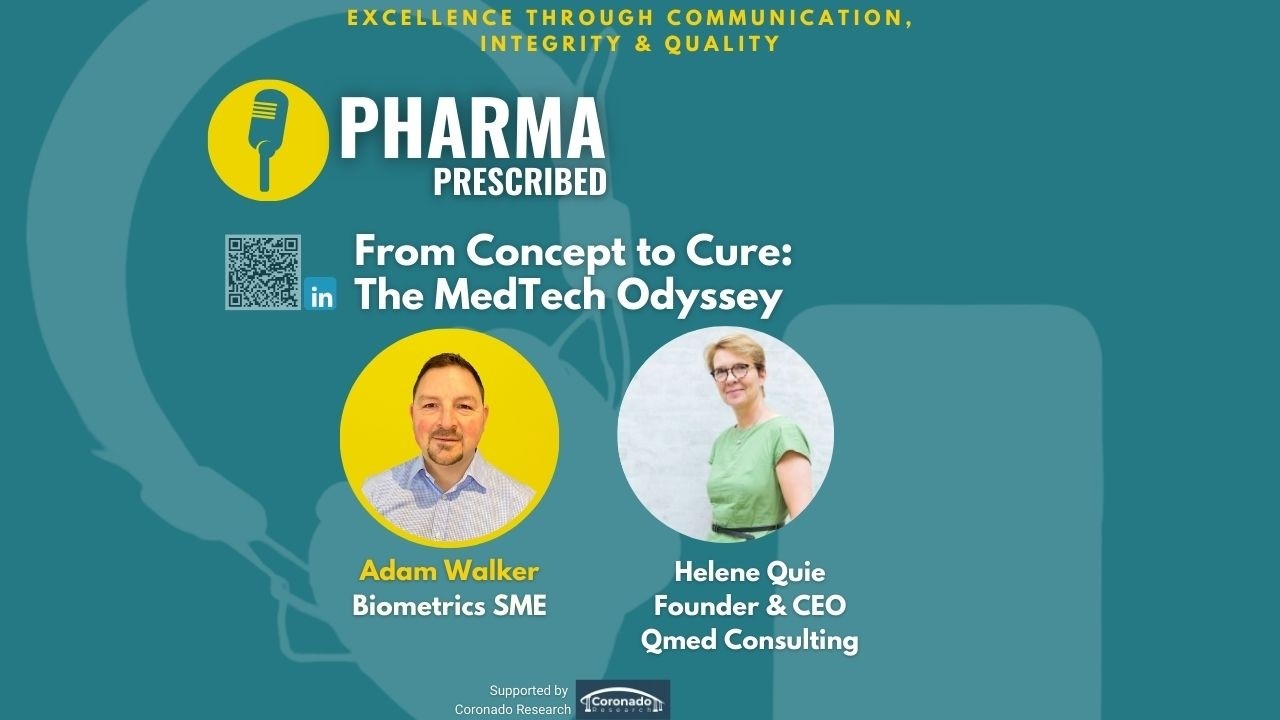
In this episode of the Pharma Prescribed Podcast, host Adam Walker sits down with Helene Quie, founder and CEO of qmmed Consulting, to explore the intricate and rapidly evolving world of medical technology. With nearly three decades of experience, Helene offers a transparent look at the 'cowboy land' roots of the industry and how it has matured into a rigorous, risk-based regulatory environment. The conversation delves into the fundamental differences between pharmaceutical and medical device trials, emphasizing why manufacturers must proactively argue for their clinical strategies based on specific product risks. Helene explains the vital importance of 'use cases' and why emerging companies must look beyond their immediate 'sandbox' to understand how their devices will function within diverse global hospital systems. Listeners will gain valuable perspectives on the importance of knowledge sharing, the Danish culture of innovation, and the 'magic' that happens when multidisciplinary teams—from cell biologists to engineers—collaborate with a common mission. Whether you are a MedTech pioneer or a healthcare professional, this episode provides a strategic roadmap for navigating the complexities of regulation, evidence generation, and organizational transformation.
Chapters
Approximate · derived from transcript
- 0:00Podcast Opening
- 1:17Meet Helena Quie: A MedTech Pioneer
- 2:35Devices vs Trials Explained
- 3:52The Evolution of Medical Device Regulations
- 5:10Navigating the Diverse World of Medical Devices
- 6:28Risk Based Regulation
- 7:45The Importance of Risk Assessment in MedTech
- 9:03Use Cases and Market Fit
- 10:21Strategic Planning for Clinical Trials
- 11:38Training the Next Generation
- 12:56Why Sharing Matters
- 14:14The Danish MedTech Ecosystem
- 15:31Denmark MedTech Culture
- 16:49Hospitals Industry Partnership
- 18:07Denmark Work Culture
- 19:24A Transformative Experience in Denmark
- 20:42Wellbeing at Novo
- 21:59Understanding the Danish Concept of 'Hygge'
- 23:17Building Strong Relationships in Business
- 24:35Roots and Wings Leadership
- 25:52CEO Decisions and Focus
- 27:10Challenges and Decisions as a CEO
- 28:28The Future of Med Tech and AI Integration
- 29:45Europe MDR and Storytelling
- 31:03AI in Medical Devices
- 32:21Quickfire Round: Personal Insights and Advice
- 33:38Patterns and Golden Rule
- 34:56Closing and Contact
- 36:14Conclusion and Contact Information
Key insights
From Cowboy Land to Structured Regulation
In the early 1990s, medical device regulation was likened to the 'Wild West,' but it has evolved into a sophisticated, risk-based framework that governs everything from hospital beds to artificial hearts.
Strategic Use Cases Define Market Success
Success in MedTech requires mapping out specific use cases for different hospital systems, as standards of care and procurement vary significantly between countries like Germany, France, and Denmark.
Documentation as a Strategic Asset
Effective medical device development relies on justifying 2,000 intermediate steps through documentation, balancing the risk level against the product’s efficiency and value to the patient.
The Power of a Flat, Collaborative Culture
Advancing healthcare requires a flat organizational mindset where engineers, academics, and clinicians share knowledge openly to transform scientific data into clinical success stories.
Newsletter issue
It used to be the Wild West
A MedTech regulatory strategist on how far medical-device regulation has come, why risk should drive the rules, and a cell biologist's mission to help the people who build things.
The written companion to this conversation with Helene Quie. Browse the newsletter archive
Loading preview…
Full transcript
Edited for readability. Speaker labels preserved. Click to collapse.Click to expand.
Full transcript
Edited for readability. Speaker labels preserved. Click to collapse.Click to expand.
Podcast Opening
Adam Walker:I'm Adam Walker, a biometrics consultant, and this is the Pharma Prescribed Podcast where leaders, innovators, and hidden voices in healthcare open up, no sound bites, no spin, just raw insight, one prescription at a time. In an industry driven by data protocols and pressure, we rarely pause to ask the human questions.
Adam Walker:What drives us, what breaks us, and what truths live behind the titles we wear?
Meet Helena Quie: A MedTech Pioneer
Adam Walker:Helen Quie is a strategic decision maker, founder and CEO of qm, med Consulting, a global healthcare consultancy, CRO, driving medical device innovation with more than 25 years at the intersection of science regulation and commercial strategy.
Adam Walker:Elena advises startups and established med tech firms helping leadership teams translate breakthrough ideas into market ready products. Her career includes senior operational roles across leading med tech organizations. In 2006, she founded QM E to Bridge Innovation and Regulation, while elevating patient safety and commercial success.
Adam Walker:Today, QED supports MedTech pioneers across Europe and beyond. Guiding clinical innovation, regulatory transitions, evidence generation, and organizational transformation.
Adam Walker:So Helena, for those of our audience who are not familiar with you, who are you and what is the mission you are on? Thank
Helene Quie:you very much and thank you very much for inviting me for the podcast.
Helene Quie:So who am I? I am, MedTech specialist. I like really to. Phrase me like that or put that label on. I've been in this industry for many years and what really drives me is this extremely fascinating industry where develop. Tools and material that can enable better health. So I am on a mission 'cause I'm not an engineer, I'm a cell biologist.
Helene Quie:I can't put things together, I can't build products. But I can help those who can do that in developing products that are placed on the market. For the patients that are sick and need help and support, and that is really what, fascinates me and drives me every day.
Adam Walker:Thank you for explaining that.
Devices vs Trials Explained
Adam Walker:Would you mind just elaborating on the difference between medical technologies and devices as opposed to clinical trials and what other people might understand to be clinical transformations?
Helene Quie:Yeah.
The Evolution of Medical Device Regulations
Helene Quie:So what's really different within this world of medical devices and medical technology is that it's extremely diverse.
Helene Quie:Both before I started QA and after you, have. First of all, an extremely young regulation. So when I started in 95 at Cook Medical, the directive for medical devices a market release in Europe just came out in 93 and therefore there were no procedures. There were no nothing.
Helene Quie:We call it normally the cowboy land because. It was the Wild West, basically. But it was also that time where we had really innovative solutions, made the interventional radiology, cardiology, treating patients from small incisions in the skin. You could treat the heart and the brain for people that were about to die from a stroke.
Helene Quie:So there has been a lot of development within the regulation in Europe and in us also, but it was meant as a free trade regulation or legal foundation in the start and has developed to really a strong foundation for how to develop devices.
Navigating the Diverse World of Medical Devices
Helene Quie:But because it's so diverse, it's hospital beds and it's also an artificial heart.
Helene Quie:It's the software application that you have on your phone, and it's the software in some of the machines that are at the hospitals, the big MRI machines. So to have a regulation really that covers all of that aspect and the whole journey has been on for the last 20, 30 years. That's where we really see this.
Helene Quie:Market. It is a market, we wanna sell these products, but we also want to sell safe products and products that performs toin. Part of that is really where the fascination comes from and it's the transformation that has been quicker and quicker over the years. Basically, it happens faster and faster.
Adam Walker:Thank you for explaining that. That's a wonderful insight that you've given us and indeed. In my past, I have also worked in medical devices, and the example I often give is the hospital bed. Being a medical device as well as stents that go into the body. And I think that's a really good insight for our audience to understand the difference because I think at last count there may be 50 to 60,000 different medical devices listed at least by the MHRA that I was aware of when I was working in that field and.
Adam Walker:It is so diverse.
Risk Based Regulation
Adam Walker:Where do you start with trying to get your arms around, not just the regulations, but how you advise companies on best practice?
Helene Quie:Yeah. Where we actually. Start normally is to explain that this is a framework, for how to develop medical devices.
Helene Quie:It's like that in Europe and US and in other regions, but we normally take Europe and US as the main regions just to have examples.
The Importance of Risk Assessment in MedTech
Helene Quie:In Europe, we are running this very much based on risk assessment, so for sure. The risk in developing a hospital bed compared to the risk developing an artificial heart.
Helene Quie:Two different things, but it's the same regulation, which is up to the manufacturer. And this is where we as a service organization, we support our clients in having that understanding and seeing the risk, not only from. From a medical perspective, but how do I transform that into my, and this is where really the gold is.
Helene Quie:How do I transfer that into my documentation because it's not enough any longer to just have, like in the old days I said the cowboy times to really have a very good products. There are 2000 steps in between where this. Risk consideration is always part of it, and is each and every step until the commercialization, you still have to be able to justify and discuss and debate the risk level and the efficiency of the product and what is it actually worth for the patient and the hospital or the user.
Helene Quie:And that needs to be built on documentation. So this is where we as a service provider, helps to get that documentation package in place. And that is, it's the same that you do for hospital bed than you do for the heart, artificial heart. But of course the detail level are two different places.
Helene Quie:So this is where you have to have some kind of experience. In navigating that because it is up to you. Where I think more in pharma, there is a difference. You'll have kind of to go through, check, check, check. You do this trial, you do this trial, with devices, you have to argue that I either do trials or I don't do trials, and if I.
Helene Quie:Two trials. I need a first demand. Maybe I don't need a first demand, but it's based on my risk. And then I do a pivotal, maybe I don't do as big pivotal trial as others has because I'm planning to do more post-market. So after it has been seen marked, so that whole argumentation based on risk and justifications and available data.
Helene Quie:This is where I think the fascination for me at least comes, you have to put all these small building blocks together and then create it into a success story for the client or the manufacturer for that specific product so you can treat patients. I think that's magnificent.
Use Cases and Market Fit
Adam Walker:I'm hearing a wide diversity of opportunity in learning as much as where do you find that expertise?
Adam Walker:Because. You referenced the fact that there are obviously many regulations that you have to follow, but if you are assisting in a cardiac device,
Helene Quie:yeah.
Adam Walker:You need cardiologists. Presumably you need experts to advise you on what might be best practice. What might work might not work.
Helene Quie:Yeah.
Adam Walker:Nevermind the risk benefit and the documentation that sits with that.
Adam Walker:Where do you start with that?
Strategic Planning for Clinical Trials
Helene Quie:I think you start by. Depending on at what stage you are with the company, you have to consider what open questions do I actually have, and then at the end of the day, you need to use your product at the market. We call it a use case. And funnily enough, here in Europe we are, I don't know how many countries, the use case per country is different per hospital per.
Helene Quie:So you really have to dive down in the detail of how my idea is going to be used when it's actually in used for a patient, and how are they being used today. So what is standard of care today at the hospitals? And this is where you need. If it's a cardiology product, you need the cardiologist, but you might need or both to speak with a cardiologist in US and in Europe, two different hospital systems.
Helene Quie:And in Europe you have different countries, so you can't pick all 28 countries or how many we are. You might be picking five. These are what I'm focusing on. Germany is different from France. Denmark is different from, so that whole strategic. Game. You have to play and position yourself selling your idea into these systems, hospital systems, because you need data.
Helene Quie:You need to set up clinical trials here. You need to check that the thought process you have behind the standard of care with your new product, that use case is actually going to fly. So there you need to strategically really think. Very clear, not stay only down in your sandbox but really up.
Helene Quie:Check it out. Can it fly? And I think this is where the companies that do this well, and we've seen a couple here over the years, they are very successful. But companies that don't have that oversight or understand that, you need to stick your nose out and get some feedback on not only your device, but actually how it's going to be used in that setting is really key for the whole understanding of how am I going to develop this?
Helene Quie:Otherwise, you will end just before the clinical trial or right after the clinical study. 'cause a clinical study is an artificial setup. You sign a contract with a hospital to do this, and they will most likely do it. But then after this, the day-to-day business might be different and no one will buy your product or few people will buy your product.
Helene Quie:So that whole setup and that understanding is really key.
Training the Next Generation
Adam Walker:Thank you for explaining that, Helena. I'm wondering. How you identify good people to come into this organization, but also I'm sensing that from your own perspective, you've learned through doing this has been the hard yards over the last 25 plus years that you've been doing this.
Adam Walker:How do you translate that for the next generation of people coming into your organization? Nevermind supporting medical devices in the future.
Helene Quie:I think it's important to teach and train and share knowledge. So I'm a big fan of sharing basically because it's it's necessary. We want all one safe products that performs and treat patients.
Helene Quie:I think. Smart and clever people can always sit down and talk about the guidances and the regulation. They can probably also talk about how to implement it and put the processes in place, but to get up a little bit in a helicopter view and see the different processes and how they could influence each other.
Helene Quie:You need experience and you need experience with situations that have both. Good and bad. So we learn equally from, from bad experience and where we have failed the hard way. I have been around the block for about 30 years. I've tried bits and pieces. I would know bad situations or when you could end up in problems, but I also learned.
Helene Quie:You can't always just tell that, you can't say the wolf is coming because no one will listen at the end, but you can stand there and help afterwards, and then guide in cleaning up because people will do it anyhow because they need the experience themselves. I think it's just human nature, right?
Helene Quie:But it is by teaching and training and coaching, telling the story, being out there, sharing. That's key.
Adam Walker:I couldn't agree with you more, and I'm aware that you've run your own podcast as well, and many of those lessons that I think you've learned along the way you've put out there into the public domain.
Adam Walker:So you are very open to sharing your information. You're not withholding that knowledge.
Helene Quie:No.
Adam Walker:It's very much a sharing mentality.
Why Sharing Matters
Adam Walker:Where does that come from?
Helene Quie:When I started out within this business, I started out at Cook Medical. And at that time, cook Medical was it's a big factory just around the corner here from where I live, and it's completely flat organizations run by us privately owned med tech company.
Helene Quie:And as I say, it was really early stage, but I learned there because the structure was so flat. By interacting with each other and because no one knew what I actually could contribute with, I think I was the second academic person hiring cook. So they were all from the hospitals.
Helene Quie:They were engineers, so they never had anyone who came with a university degree within cell biology. They had no clue, and I probably didn't have a clue what I could contribute with. I just. Actually wanted to become a doctor and I was too lazy in the high school. So I had to find out how do I get close to this world?
Helene Quie:So it ended up with cell biology where I knew physiology, anatomy, and other things. And I didn't use the cell biology part that much, but I used the medical part of my education. But I came with a structure and I think. I taught some of the people in the groups that I was working with at Cook that by having structure, making plans, making protocols, tracing the data, which I learned at the university, right?
Helene Quie:You test and then you go backwards and you test again. Then you test again, and you do that three times that whole mindset helped me, but it was together. I had to. Transform that into a language that, these engineers in the other room, they actually understood that she actually comes with something here some numbers.
Helene Quie:And when we've done that, I can do this next step and I can speak with that physician and I can actually use that to convince him to do this. Maybe we did a lot of, anatomy model testings at that time for sealable aneurysms. Okay, maybe we can do that into a verification test model. Maybe we can move outside of the house and do testing actually closer to the physician and then the marketing people call and say I think I want to join these meetings.
Helene Quie:You're close to my customer. You know what? And then we started up. I don't think that we exactly knew what we were doing, but I at that learning that. By sharing my basic DNA with others just made these the best days of my life. I had so much fun, I learned so much, and I brought that into that.
Helene Quie:If we do this, sharing what everyone can do here, we will make magic. But it's the only way. You can't sit in a box and make magic, then you are a magician. But we are not, we are just hardworking people with some skills and competencies, but together we really do magic every day.
Adam Walker:I think that's a wonderful insight that you share there.
Adam Walker:We have. Many things in common, but one of them is also that I also wanted to be a doctor.
Helene Quie:Yeah.
Adam Walker:And unfortunately I wasn't able to do a medical degree either. And almost word for word, as you say. I just wanted to be around doctors. I say the same all the time.
Helene Quie:Yeah.
Adam Walker:I don't care if I'm not the smartest person in the room, I just wanna be around medical anything.
Adam Walker:Yeah. Medical people, medical, anything. So we have that in common. And also the way that you describe the scientific methodologies. It's so similar.
Helene Quie:Yeah.
Adam Walker:To the way that my brain works as well.
The Danish MedTech Ecosystem
Adam Walker:And on a third point, you know that commonality, you are based in Copenhagen, in Denmark.
Adam Walker:It's a place that is incredibly close to my heart, having lived and worked there for a couple of years in 2015 to 2017.
Adam Walker:The mentality of the Danes. I need to touch upon that because you've described it. I see it and I hear it in everything that you're talking about, but perhaps you can elaborate around that because there is a certain culture of openness and warmth and care that I experienced there in, in Copenhagen, in Denmark particularly.
Helene Quie:Yeah.
Adam Walker:That I'd love if you could just elaborate a little bit more about that.
Denmark MedTech Culture
Helene Quie:Yeah, I can. So Denmark is a small country. We are very few people actually. When you get to, with 6 million people, of the 6 million people, half of us are working, half of the half is working in the public and the other half is in private.
Helene Quie:Sometimes we are competing with the Finn and the, I think the Norwegian people in being the happiest people in the world. But we are, I would call it, we are super spoiled in a system where we've been. Normally treated well and that we have opportunities to go to the university. It's the tax money that pays for us to go there.
Helene Quie:It's the tax money for the hospitals. We have a culture, I know we talked about the round tower in Copenhagen. We have an office just next to it, but there is a history, right? I'm sitting next to the round tower that Kristen IV made. In 16, I think it's 40 42. It is actually, it's the coat for the door and then plus something.
Helene Quie:So every time I forget the coat to the door, I look at the round tower and then someone told me the other day, you have to add a couple of numbers. I didn't actually realize that, which is embarrassing. But we have a culture of being around for a long time. Being a large country.
Helene Quie:So we have also this, we are good at some things and we are very good within MedTech. We have very smart people within MedTech and we have some very large companies that contribute. They stay in Denmark, they pay the tax, they pay to our whole system, and they actually feed into a system that within innovation to nurture that industry back.
Helene Quie:It is within pharma. It's within Med Tech. Nova Nordisk is one. Cook is in Denmark. We have a radio meter. We, I have a lot of large companies, so Med tech is a big industry. The universities have specific branches to degrees to develop. People into that industry. They're picked directly from Nova Nordisk and other organizations right from the university, and then they pull 'em through a program, but they have the basic knowledge and having that a lot of smart people within this industry just makes it a very interesting place to be basically.
Helene Quie:And because we are small. We don't stay here. Like we could look in other countries, Americans, they're very American and when you have France also tends to stay in France, but in Denmark we have to reach out because there isn't enough here. There isn't enough Brainware, there isn't enough money in the system.
Helene Quie:There isn't. We have to spread out also for other markets. So that combined with a lot of competence and no. And that, the Vikings crossed the big ocean and went to America, and we have that. We don't stop because we are just too small, right? So in our teens, I think there is a good basis for this industry, and I'm pretty proud of it actually.
Helene Quie:A lot of good ideas comes out of here.
Hospitals Industry Partnership
Helene Quie:The heart valve, for instance, was made the first one, if I remember correctly, at one of the hospitals in Joplin by well-known physicians. So we have some very good places there. And that's the last branch. This hospital is very close to the office.
Helene Quie:It's six minutes with the bus. I can go in and say hello. To a doctor and they are available, they make themselves available. It's also important for the hospitals, they have it as a business to support that industry and they're also earning money. So it's not true just that they're saints. They make it as a business to be part of this whole med tech universe and be part of developing new products and be part of clinical studies.
Adam Walker:I really appreciate that insight that you shared there, Helena. And it echoes the experience that I had working alongside many people at Nova Nordisk when I was located in Copenhagen. It was that sense of contribution that everyone was contributing.
Helene Quie:Yeah.
Adam Walker:And this isn't a political point, but what I noticed very much was that it was so different to the experience I'd had back home here in England.
Adam Walker:And in various other countries that I'd worked and traveled to because.
Denmark Work Culture
Adam Walker:That contribution is in the DNA of the country. As you say, people are funded to do two degrees. Everyone can do two degrees. That's remarkable.
A Transformative Experience in Denmark
Adam Walker:Beyond remarkable. And in every meeting that I was present, there would be far more qualified people than me with multiple degrees speaking multiple languages.
Adam Walker:Highly capable people working in all sorts of different fields. It really was transformative for my career as much as from a personal point of view, because when my wife and my kids came and visited and we had holidays
Adam Walker:In Denmark, they also saw what a remarkable country it was, how kind the people were and how welcoming the nation is to, to people coming into the country.
Adam Walker:We had some incredible holidays there, and we also just experienced a lot of wonderful culture.
Adam Walker:Not least the food, the lifestyle, the outdoors, and that happiness thing that you speak about. It's not a cliche to say that the people that I worked alongside were happy, even in the darkest of days, in the winter months when we were cycling to work in the dark, cycling home, in the dark,
Helene Quie:at
Adam Walker:the end of the working day.
Adam Walker:It was a different experience to what I experienced here in the uk.
Wellbeing at Novo
Adam Walker:I can't quite put my finger on it, but the first day that I started at Novo, they gave me a bicycle.
Adam Walker:That was my welcome gift.
Helene Quie:Yeah.
Adam Walker:And it stayed with me for the two and a half years that I was commuting there.
Helene Quie:Yeah.
Adam Walker:And I also went to spin classes after work.
Adam Walker:I went to yoga classes. We had stretching together.
Helene Quie:Yeah.
Adam Walker:We had Fridays with cake.
Helene Quie:Yeah.
Adam Walker:Everything that I was exposed to was just on a different level of Wonderful. Yeah.
Understanding the Danish Concept of 'Hygge'
Adam Walker:And I learned what HOA really meant. Perhaps if you could tell me what HOA means to you, because I can't translate it.
Helene Quie:Huga. Yeah. It's a Danish word that doesn't exist.
Helene Quie:I think in other languages the situations and the feeling might be there, but it's an Danish expression hugger for that thing that we have together. I normally say because I try to get my family close to me, so they all live around here and I normally say we just hang out. We just spend time together.
Helene Quie:And that's hugger because it's not with a purpose. You are not guest. You just join me in my house and we spend time together., I try with our clients. I try to spend time with my clients just to get to know them because there Are people behind, and of course there is a business part, but I'm equally a people's person that I want to get to know the people that I'm working with.
Helene Quie:So yes the business part, we are earning money on this, that's for sure. But it's.
Building Strong Relationships in Business
Helene Quie:Ideas and the whole, community around that company is important to understand, but this is where Huga comes from and it moves into the companies, right? As you say, we have now 40 employees in total and important part, I'm being asked all the time, and I'm unfortunately a little too busy, but they have this need to have ku.
Helene Quie:For sure they want to do a run together after work and they want to have cake in the afternoon. And it comes by itself over time that they have these connections and they create that really strong relationship to each other, which is great and it makes it. Much more fruitful to go to work beside developing devices.
Helene Quie:They're also developing relations both with the clients and internally, and I find that extremely important.
Adam Walker:Yeah, I absolutely echo that and couldn't agree with you more.
Roots and Wings Leadership
Adam Walker:You mentioned about the size of the company. I would imagine that most of those people have been with you for a long time, haven't they?
Helene Quie:Some has, I like that people stay as long time as possible, but I also know within the world where I work being a small company, if you have ambitions it, might not be the last stop with me because I'm too small. Then go up. And then you come back, come back when you're ready.
Helene Quie:I can't always develop people in that direction that they want because of the size of the company. We also are flat in our organization, so I can't develop 10 different layers of managers so they stay people look happy, content, then I'm happy. But they don't always stay forever and I don't expect so.
Helene Quie:Because you have to move, you need to get out there and get some experience and then come back when you're ready. So that's my philosophy in a way.
Adam Walker:I think that's a really. Pleasant way of looking at it is you give people roots.
Helene Quie:Yeah.
Adam Walker:And you give them wings. Yeah. It's a bit like being a parent, isn't it?
Adam Walker:Yeah. It's the same that I, my wife and I say to our kids, yeah. You've always got a home. Yeah. Whenever you want to come back.
Helene Quie:Yeah.
Adam Walker:But in the meantime, jump on a plane and go and Yeah, go and see the world.
Helene Quie:Yeah,
Adam Walker:come back when you're ready.
Adam Walker:Yeah.
Helene Quie:It's
Adam Walker:the same principle.
Helene Quie:Yeah.
CEO Decisions and Focus
Helene Quie:'cause there is limitations.
Helene Quie:I would love to do much more, but it's then not a good business. And if I don't have a good business, it's not solid. And no one is happy.
Challenges and Decisions as a CEO
Helene Quie:So there are choices you have to make as a CEO. And it's the same when we talk to our clients there. Sometimes I see these clients that wants to do everything and I'm just, whew.
Helene Quie:You have to take a decision here my friend. You are. Killing yourself will, I can see the ambitions. I can see both with the device and the people and you are too many or you are too few and it's wrong competencies, or it's the wrong use case, or you have to focus and you have to find that we either call it the red thread or the golden thread, but you have to build up that story.
Helene Quie:And again, sometimes when the employees that the clients have around them might not be the right fit. Of course there we can step in, but we will never become the company. Even though that we try, so I think that's important discussions that actually I enjoy having with CEOs and other strategic developers that you have, to take decisions and every decision means that you take something away, right?
Helene Quie:But it makes it clearer and it brings you closer to a success. Either success to close something down or success to actually get something to the market. If we say that we are all here to develop devices then I think that's clear. If it's too muddy, you will fail, unfortunately.
Adam Walker:Yeah. I think to get a perfect decision, it never happens, does it?
Adam Walker:I've heard it said before, 51% is good enough to make a decision.
Helene Quie:Absolutely. Absolutely. Sometimes when we do seminars and we see startup companies that have been startup companies maybe for 10 years, then I get concerned on their behalf. Even your use case, which was a good idea 10 years ago, might not be a good use case today.
Helene Quie:So why are you still around? Might be a good idea, still might be a good idea, but it might also be that you're stuck, right? And you can't move on. So why? Why are we doing this? So I think these discussions are important to have. And of course they have become a very old, very irritating woman in the room.
Helene Quie:But I think it's important to talk about don't waste people's money all your time in something which are not supposed to be happening.
Adam Walker:I think that's a rich insight to, to share.
The Future of Med Tech and AI Integration
Adam Walker:I also wonder, given your experience now, what is it that you are seeing for med tech and the future? Because things are changing really fast, aren't they?
Adam Walker:You talked about people sitting on an idea for 10 years. I don't think anyone's sitting on anything for more than 10 minutes right now.
What that might play out like for ChemED.
Helene Quie:Yeah. I think that the world is a little bit turning upside down these years, and it has been, I've been doing this for 20 years, so I know it goes up and down and I stopped getting a heart attack every time it goes down. I realize this is happening, but what really has changed is that it, moves with a much higher frequency, the up and down and these days I think that we are in a period where there are some worldwide changes, disturbances, changes in the process, and that makes people insecure.
Helene Quie:There is actually, as far as I can see and hear enough money in the industry, but the security in making sure that there actually, as we just talked about, that the products get out there on the market and that you can sell it. They want much more security that this actually happens. It means that money goes to fewer, but more money goes to these companies.
Helene Quie:It leaves startup companies without funding for 10 years, but will maybe not a good idea and they have to take that decision how they're going to, move on and average. Medical device, it's about two to three years on the market. Then something else is being invented and over a period that product will die out.
Helene Quie:That's the difference from pharma where you have much longer leadway devices, they come and they die, very quickly.
Europe MDR and Storytelling
Helene Quie:So I see that as a change, that the money flow has changed with the new regulation in Europe. The narrative around how difficult Europe is still existing. I'm working very hard to try and change that because Europe is still the second largest market.
Helene Quie:The fact that we got a new regulation is not what really hinders us. To develop new devices. There is a lot of the new innovations that goes to US FDA is really happy these days. They even make surveys to document how good it is to go and, introduce new innovative devices in us. While we are still struggling a little bit with our storytelling around MDR, and again, because we are different countries, the European Commission and FDA is one, place, one unit, one books.
Helene Quie:We have some troubles getting our ducks in the row and get the story right. But I see so much innovation and I see a lot of great ideas and companies that are really growing and they are stumbling and they get in trouble because the importance of building that red threat, the golden threat or whatever we call them, has become so much more important.
Helene Quie:You cannot. Have verification, validation, clinical studies, they cannot be separate anymore. You need to build up that whole story into one story. And if you don't have that right from the start, you will get delays and you will have more failures and so on. So I think that's where we are right now, but, and how it influenced the zero business is that. I think the main business has changed a bit and we need to reflect the world around us and as I can only speak for myself, but I ask a lot of questions to other zeros, I can. Here and when I listen to them that they're also in a restructuring phase and adapting that new universe.
Helene Quie:Very much focused on US Europe, still struggling a bit larger companies, but with a lot of funding. And how do we then fit in because we are the extended arm between. The authorities and the understanding with kind of the glue that helps where the companies can't do themself or choose not to.
Helene Quie:So how do we now fit into that space? I think that's changing. That's what I spend my walks on when I'm thinking about how to do this. It's different, but it's doable.
AI in Medical Devices
Adam Walker:And dare I ask. Do you see that there is a change coming with the advent of AI machine learning and overlaying that within the medical device arena?
Adam Walker:Have you seen that firsthand?
Helene Quie:Yes. I do think that it is already there. It is the both the regulation now needs to be implemented and understood and how we need to work with it. But the whole thing of integrating AI and all the processes where it's applicable and still have the human oversight, that's the fine balance we need to find because it is a magnificent tool.
Helene Quie:I enjoy it a lot because it is challenging my brain where I don't have enough capacity myself. It's not because it's always right, it definitely isn't. But it challenged my way of thinking and the processes, the other processes that it sees into situations that I didn't see because I'm preempted for something with my story, my history and it gives me new
Helene Quie:perspective, I can take it or I can leave it. So that's up to me still. But I get much more opportunities and I really I like that. But it's it's regulatory wise, a burden for the devices and all these things, but oh my God, it can do magic. Really. I'm impressed.
Adam Walker:I agree with you. And coming back to that scientific methodology piece.
Adam Walker:It's like having another. Person guiding you sat alongside you. A very highly experienced person. Yeah. You don't always agree with them, you challenge them back.
Helene Quie:Yeah.
Adam Walker:But it really is very powerful and Yeah, and worthwhile isn, isn't it? It's certainly in smaller organizations where you need sometimes a spark of imagination or an idea.
Helene Quie:Yeah, exactly. No, I think it's it shows you where the holes are. Of course you need to prompt it in the right way, but, no, I think it's becoming a really great tool and, but again, it probably will change the way that we are working because we will be the same people at the companies that are then now producing the documents and then we are checking the documents.
Helene Quie:We are not necessarily producing the documents. The AI tools can do that. Maybe the person at the company don't have the competencies to prompt it. Document the right way, then we will do that and then they will check it with the AI tool at the company. So we get an extra hand actually in that. It's becoming a triangle and we see clients that are actually asking us for proposals will and without use of ai.
Helene Quie:So it's already there.
Adam Walker:It's really interesting to hear and thank you for elaborating on that. Helena.
Quickfire Round: Personal Insights and Advice
Adam Walker:At this point in the conversation, I like to conclude with a quickfire round. I'm wondering what is the one piece of advice you would give to your younger self?
Helene Quie:Have more patience.
Helene Quie:I'm extremely impatient, but I learned the hard way to breathe. Wait. Then it will come patience.
Adam Walker:What are the top three qualities you value most when building a team?
Helene Quie:Ooh, I like the humor. Let's also have fun, right? If we can both have humor and really skill bright discussions, and then. We have empathy for each other, then I'm, go for it.
Adam Walker:What is your favorite thing outside of work?
Helene Quie:I have four grandkids and I know I skipped the level of my daughters, of course, all my daughters and my, but my family, I really enjoy spending time because, I have three boys and one girl under six years. You just can't think of work. It's the skater park or it's the, you have to see the new drawing and you just, can't think about a new heart valve, right?
Helene Quie:You just have to be there present.
Adam Walker:You've given an amazing insight in there and I dunno how you fitted in all those children and grandchildren and built that career, by the way. You
Helene Quie:just have to just, you know what they can do? They can do FaceTime. So that's how it is. If they insist on your presence or they call you on FaceTime the other day it was.
Helene Quie:The one at six, he called my husband and said can we hang out on FaceTime? You have to be there.
Adam Walker:It's very similar. My, kids are both at uni and they do the same. They FaceTime. Yeah. Middle of my working day. Middle of my wife's working day.
Helene Quie:Yeah.
Adam Walker:And same thing. They just wanna be in the virtual room with you, don't they?
Helene Quie:Yeah. Just be present here. Now I need to speak to.
Patterns and Golden Rule
Adam Walker:And finally, what is your number one golden rule in life and in business?
Helene Quie:Golden rule.
Helene Quie:I think my golden rule is that there is always a pattern. So if I keep an eye on the patterns, I'm academic, so I look for that red thread. There's always a story. Things fit together. And it doesn't always come, there's nothing out of the blue. It comes from something and then. If you prepare yourself and your mindset, you'll both be a good person, a good boss, and a good grandmother and mother.
Helene Quie:So just watch for that. That's my rule.
Closing and Contact
Adam Walker:Thank you, Helena. We've had a wonderful conversation today. I've really enjoyed not just getting to understand a lot more about QED Consulting, but also from a personal level. You shared some really rich insights into your. Drive and determination in building an organization and the learning that has served you all the way through that, nevermind the principles that I absolutely align with in and around the Danish culture.
Conclusion and Contact Information
Adam Walker:So thank you so much for coming on, farmer prescribed today. For any of our audience who'd like to reach out to you. What's the best way of making contact with you, Helena?
Helene Quie:In these modern days, I. I think I have about five, six platforms. As I said, my grand sons are using one of them, but LinkedIn for sure, or the info email or just email.
Helene Quie:In these days, calling me is a problematic because if I don't know the number, I might not pick up because it might be someone from China. But the other you route LinkedIn info, email, just find me. I'll always answer. And I'm always open for a cup of coffee. I'm interested in. Hearing from people where the good stories are.
Adam Walker:Thank you so much, Helena. It's been a delight to welcome you on Pharma Prescribed today.
Helene Quie:Thank you for inviting me.